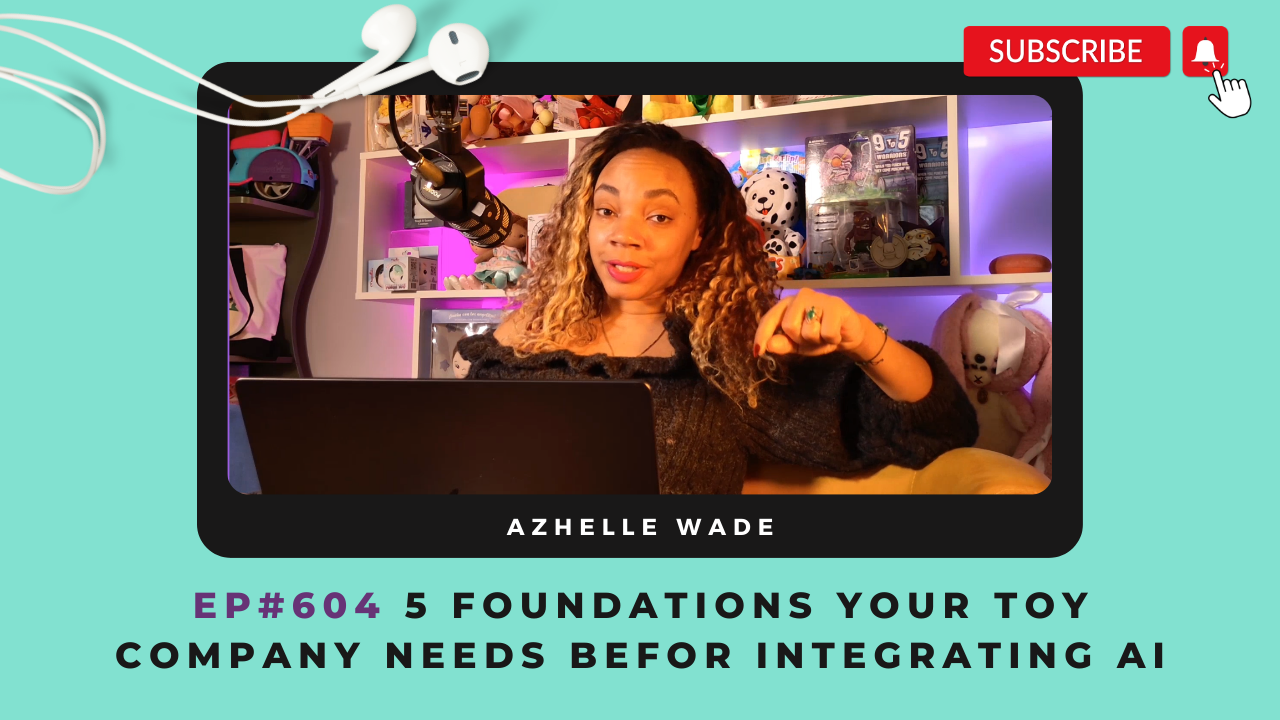
So I finally convinced you that you can't ignore AI… and you're ready to implement it in your toy business.
Go you. Love that for you. 👏🏾
But before you go trying to haphazardly plug AI into every little task, you need to build your AI foundation.
Your AI foundation is a series of files, records, strategy, and frameworks that you as a business use on a day-to-day basis. You may already have it documented somewhere, living in your head, or is just something your team knows how to execute.
In today's episode, I'm breaking down exactly:
- What you need to document
- How to pull that information together
- What you're actually going to use it for
- And how to use it to benefit your process TODAY.
I'm also sharing a tool I made that will help you build this foundation a whole lot faster.
I know I say this all the time, but… DO NOT miss this episode!
Key Moments:
- 00:01:00 – Why you cannot layer AI on top of messy data and undocumented processes
- 00:02:00 – Foundation #1: Your Golden Data (sales data, product list, customer profile)
- 00:11:00 – The brand voice problem that makes AI sound generic (and how to fix it)
- 00:14:00 – Foundation #3: Your tech stack audit
- 00:17:00 – Foundation #4: SOPs (yes, you must have them)
- 00:21:00 – Foundation #5: Folder structure + the "Chief Operations Officer" prompt
For the links mentioned in this episode visit: thetoycoach.com/604
Mentioned In This Episode
AI Blueprint Tool:
thetoycoach.com/ai
Toy Coach Showcase:
learnthetoycoach.com/showcase
Ready to implement AI into your business? Email Azhelle at:
info@thetoycoach.com
Have an idea for a toy or game? 🧸 Click here.
Do you have an idea for a toy or game that you think could be the next big thing? Join the Toy Creators Academy to learn how to bring your toy idea to life! Or book a 1:1 call with Azhelle to get personalized guidance on your toy journey.
Episode Transcript 🔗
Azhelle Wade: [00:00:00] You are listening to Making It in the Toy Industry, season six, episode four.
Hey there, toy people. Azhelle Wade here and welcome back to another episode of Making It In The Toy Industry. This podcast is brought to you by the toy coach.com for season six. As a reminder, we are discussing all things ai.
Today we are talking about the foundation you need to instill in your business before you bring AI into it. Whether you start using custom GPTs as a regular part of your development process, or if you actually build your own custom make or Zapier automation that integrates AI reasoning to simplify any of your toy development, production, or sales processes.
If you bring in an AI consultant like myself to into your business to build a custom build, these are some of the things you need to have set up in your foundation to make all that work. So that's what we're gonna cover today.
last last week [00:01:00] I showed you an AI system that I built that executes.executes three days worth of my work in 60 seconds. And I know you must be thinking, how do I get that? I want that. But here is the the hard truth. Before I built anything, I actually spent about a week organizing my business, organizing my data. I created Google Drive folders. I reorganized my Clickup list.
I documented my frameworks I built standard operating procedures for my business. Total boring stuff. When I started to do that work, it wasn't actually because I planned to do ai. It was just because I'm a new mom and I thought I should get more organized. I wanna make it easier for my team to find things but.
that organization step ended up being a huge benefit when I started to integrate AI into my workflows. if you start to integrate AI and you start to build in AI systems on top of your messy data and [00:02:00] your undocumented processes, you are going to get output that feels not totally true to your business voice You also might create a workflow that feels more heavy to you than it should, even though AI is executing tasks, you feel like you're still doing a lot of admin work to get that to happen. so to have a workflow that feels as easy as I described last episode, sending a Slack message to a private channel in a tool you might already use, you have to have your systems organized enough to make that happen.
So. we are going to get you organized. We're gonna cover the foundations you need before AI can help your toy business.
Foundation number one, the Golden Data Store.
this is the secret sauce behind your business, And this is the stuff that you likely only share with potential investors. This is the stuff that probably helps you build the products that you create.
So this is proprietary stuff.
the foundation one, [00:03:00] the Golden Data.
Golden Data is going to include your sales data, your product list, and your customer profile. These three things should be able to answer questions like, what is your top selling product? last month and last year, what was your highest performing launch and why? what are your current product offerings?
What were your past product offerings and what are their price points and what are their payment plan options, if you have any? the customer profile piece. Who is your ideal target customer? what successes have they had in relation to your business, or what positive reviews have they given your business?
within customer profile, you could have a customer profile, but you could also have customer reviews. So with all this information. You and the AI that gets this in this data should be able to know what your top products are, what customers are saying about your product, the differentiator between your brand and others because your customers typically say that.
and What were [00:04:00] your sales for the last month, the last year, and what are your product offerings?
Let me provide an example for how this showed up for me. when I looked for my golden data and the information that I needed to give my AI to execute, for me, the first thing I needed to share was sales data. Every time I do a launch for a big program or an event like the Toy Coach Showcase that's coming up in June,
go to learn the toy coach.com/showcase for more info on that. Okay? Small commercial. when I have launches for events or. Programs or products, I create a launch debrief document.
I do this every launch. That debrief document holds information like the date that the, launch started, the date that the launch ended, how many promotion emails I sent, what ads I ran, how much money we spent on, social media ads, Google ads. if we did any, masterclasses to get people interested in [00:05:00] this product, it would hold data of what masterclasses did we do, how many people attended, how much did it cost in ad costs to get those people to attend?
And then it tracks. Sales, like how many sales did we make? what payment plan did people use? Did they pay in Fuller? Did they get the payment plan? How many people were alumni? It is a very detailed breakdown brief that I do after every launch to see how sales went. And the history of those documents over the past five years were so valuable to plug into my AI tool because it gave it a clear understanding of what works and what doesn't work.
let's talk about this one for you, for your specific scenario, if you're selling a toy product.
What you're really gonna pull is your sales data. if you have Shopify, will have a sales data history. You can also pull sales data from Stripe. I would also then recommend that if you are running ads like Google ads and Facebook ads, that you pull the corresponding [00:06:00] ad. data from inside of your ads manager that matches up with your sales data to give the AI tool something to compare.
So okay, from January, first to December 1st, 2025, these were my sales. And from January 1st to December 1st, 2025, this was my ad spend.
Now, before you. Uploadyour golden data. You have got to protect your customers. So you have got to delete the last name and the email address, and if IP addresses are pulled when you pull your sales data, that is all stuff you have to delete. For me because I do a, launch debrief for my products. I didn't have to do that because I don't include my customer email data in those launch debriefs.so that's also a benefit of doing something like a debrief every quarter of your sales and your ad costs, because then you'll have this clean document you can upload without worrying about, breaching your customer's confidentiality. Okay, so one part of your golden data is the sales data. Very [00:07:00] important part. it's really profit data. We should call it the profit data because it's sales and, add costs.
The second piece of your golden data is the product list. I started this like four or five years ago because I had a more junior accountant working with me at the time, and that accountant really wanted to know, like every time she would see a sale in my backend, she didn't know what it was for.
And she would constantly ask me like, what's $7? What's a hundred dollars? What's $2,000? eventually I built this price list and I was like, girl. This is what costs, what everything costs. If you see a sale for this amount, this is probably this. over the years I just kept updating this price list.
So now I have this running document, this running price list that I check quarterly and I update quarterly that lists every product that we offer here at the Toy Coach. Every service, every event, and the cost of it next to it.
That product list has been, has proven [00:08:00] such a beneficial tool when working with AI in my business because now I can upload my product list data and say, Hey, I really need to come up with a plan. In 2026 to generate more revenue from my one-on-one offers, which of my one-on-one offers has the best potential?
and if I couple that with like my sales or my profit data, then that's gonna give the AI even more information to sift through and reason against. All right, your third piece of golden data is gonna be your customer profile. Your customer profile is everything. there's a few ways to do this now.
I
when you are developing your product, if you're developing it alongside me or someone who does product development in the right way, you are likely doing market research. That market research will result in you getting a bunch of written comments about. Your product, it'll result in you getting some, feedback, like maybe on a number scale [00:09:00] about your product and really clarifying the customer profile for people that would want your product.
Now sometimes you also summarize that data so that you can, at a glance, know people, generally like the price point of 10 99, or people generally want, flashcards over a game.
That is one level of your customer profile, but as your business gets more defined and developed, you no longer would use that survey because you will actually have had real customers and you will be able to develop a customer profile that is more accurate to who is buying, not just people that said they might buy.
so just consider, depending on where you are at in your business, your customer profile might be comprised of survey results and market research results. Or it might be comprised of data you've pulled about people that actually spend money on your business.
so there's actually an AI tool that might be able to help you with this. I'm gonna recommend Claude Cowork.
Claude Cowork is designed to be a tool that helps you actually [00:10:00] execute work like you're doing work with Claude, and it's actually doing active work with you, and it can work with files on your desktop. So what I would recommend, if you want to use Claude Cowork to do this, you essentially wanna go into Claude Cowork and say, Hey, I need help gathering.
My company data into one, easy to access place. I need to gather my sales data over the past year, my product list data and my customer profile. I know where some of those files are, but I might need to give you raw information like an email chain or a, survey response or a, export from. from QuickBooks and I might need you to, to gather all that information and organize it for me.
so that's what I would have you do. you could use a tool like Claude Cowork.
Before we move on, I wanna mention the AI blueprint that I've put together we've been talking about getting your data structured, but there is a one piece of data that a lot of people [00:11:00] forget. They need to feed into their AI tool, and that's the reason their Outputs feel so generic and so cold, and we all know it's ai.
that one thing is your brand voice. if AI doesn't know how you talk, who your customer is, what you stand for, and what frameworks you use, then it really just can't sound like you. it just starts sounding like. a amalgamation of all of the information it's been taking in over the years.
So I have built Something to solve this. It's a system to help you develop your AI blueprint. it is a structure document in which you will capture your brand voice. and then it's paired with a custom GPT that will walk you through the process of building it.
This custom GPT is essentially your brand manager. so with her, you are going to be. Answering a few questions, uploading this document, and that brand manager will parse through all that information and output for you a structured AI blueprint. And you can use this like today and you [00:12:00] will immediately see a change in how your AI is responding to you.
once you get this final AI blueprint document. Any prompt you type in, let's say to chat GBT or a new project that you open, you will upload this AI blueprint as a knowledge based file. So in chat, GBT, they have like projects and clawed, they also have projects. And if you start that project by uploading a big knowledge file, like a blueprint for your business, that.
Project will reference those knowledge files throughout the responses it gives you, and thereby give you more accurate, more true to your business, more feeling like you responses. Oh and the link to get it. head over to the toy coach.com/ai to grab the AI blueprint.
Let's move on to foundation piece number two, your frameworks. Okay, so. When I was first starting my business, it was all the rage to have a framework that was unique to your [00:13:00] business. It was episode two in this podcast when I was inspired to create the four toyetic principles,
and they have been an important part of how I evaluate products in my toy reviews on YouTube. The way I talk about toy development and design on this podcast and the way that my students talk about toy development and design. I've even had a client, go to a toy show and start talking about the toy principles that someone else in the industry.
So I need you to sit down and identify what your key frameworks are. Now, if you are not an education company, you might be thinking Azhelle, I don't have frameworks. You still have core beliefs, reframe frameworks for you into core beliefs.
So what are The core beliefs of your brand and those core beliefs can bleed into your email copy your social media, captions. the types of product that you create.
So I'm gonna use one of my clients, Courtney as an example here. Courtney has a brand called Play Core, and it's beautiful toys designed [00:14:00] to look like home decor. Your kids' toys can add to the beauty of your home. They don't have to take away from your aesthetic. They can add to it and still have a strong intrinsic play value for the kids themselves. That core belief will easily influence Courtney's emails, her future product launches, even partnership she might be considering in the future.So that's why it's important to document those core beliefs. And upload them to your AI tool. That might be helping you with copywriting, launch planning, product development, because you need it to reference those core beliefs or your frameworks.
And that is going to be another document we save in our AI foundation folder, and that we're gonna eventually upload to our AI tools. All right, foundation number three. we need a list of your tech stack. This is so, so fricking important. Your tech stackare all of
the technical [00:15:00] tools, so it could be Shopify, it could be Stripe, it could be PayPal, it would be your email service provider like MailChimp. It could be the tool you use to collect reviews.
Your tech stack is so important for an AI to understand because as AI develops and grows, there will be more and more ways to integrate your tech stack into an AI enhanced process. So if you want AI to be able to help you identify opportunities to enhance your workflow, with ai, it's gonna need to know what.
Tech you already use in your workflow. another great thing you can do with having a documented tech stack. Is you can analyze your business costs. Like do I need all of these tech stack pieces? What are they being used for? Are they regularly even being used?
Let's talk about how to get this tech stack, the easiest way to pull your tech stack. If you're feeling like, oh my gosh, I have signed up for so many things I don't even know anymore. You wanna pull your, Past expenses list over the [00:16:00] past year, maybe the past 18 months. if you're thinking there might be some things that didn't quite get caught in the last 12 month window.
but you wanna pull at least a year's worth of data from your QuickBooks. Expenses only. You can delete any information that might be, sensitive. And then you want to upload that list into your chat bot tool and say, this is my most recent expenses. Can you identify all of the SaaS tools or the tech stack tools that I'm paying for
In my business. And in the same prompt, you should also ask it to identify how much you're paying and if you're paying annually or monthly. And then I would ask it to export all that data as an Excel file.
so that's just neatly organized in columns and rows.
so this audit of tech stack stuff, I mean I think it could take you maybe 30 minutes at most.
Okay. Let's move on to foundation number four. [00:17:00] SOPs Standard Operating Procedures, you must, must, must, must, must. Must, must, must, must. Must. Have this, there is no excuse. if you hire an AI consultant, they are going to likely have to make this first, and they are going to charge you for it because you cannot integrate AI into your workflow if you don't know what your workflow is and if you don't have your workflow documented.
So. Even if it's just you by yourself or you plus a freelancer, you hire once a month, you need to document your standard operating procedure. Okay. So when I first started, I did this. There are a lot of ways you can easily document your standard operating procedure.
Next time you hire somebody to execute a task in your business, just ask them to write down every step that they took. Tell them you're trying to make a standard operating procedure process so you can improve their [00:18:00] workflow and you need them to document everything. That's what I did back in 2020, because there was no ai so.
The second thing that you can do is you can use this tool called Scribe.
So say you're like, fulfilling an order or uploading a product, you would just hit. Start on Scribe, you would do that process and scribe will document through, images and text what you're doing. and then that becomes your SOP. You have to not have a DH, D and like focus, because if you like jump to another tab, scribe is recording that as well. but that scribe output. Is your SOP that you can save and then you can upload into an AI tool. the last thing that you can do to create an SOP, you can just describe your workflow to chat GPT.
I did this, most recently because I had some updates to make to my old SOP, my old standard operating procedures. What I did was I uploaded my old SOP and then I went into a [00:19:00] chat with chat, GPT, tap the voice function.
'Cause I did not want to type all of this and started recording. I just described what I want the SOP to be. So I explained the whole process, verbally. Natural language, and it translated all of that into an SOP.
Then I reviewed it. I sometimes made a few changes manually, but sometimes I would just voice note and say, no, step four that you wrote isn't right. I kind of want it to do this, and just kind of have a conversation back and forth to establish my SOP as I actually started to implement it on my backend,
I had to update the SOP. Is it a headache? Yes, but you know what happens now? One, I can say, Hey, my process for uploading my podcast feels very slow. Is there a way to integrate AI into this process and enhance it? And it will say, yes, you could do, you could enhance it with AI here, there, and give me suggestions on how to improve my workflow the second benefit is now I can have natural conversations [00:20:00] with my tool about my process. If I'm having a problem with backend automations, because my AI has my standard operating procedures, I can say, Hey, we're having a problem with the automation that's supposed to trigger on operating procedure.
Step number seven. Do you know what could be causing this? You have got to document all of your processes, big and small. Even the small things that you're like, I only update products on my site like three times per month. I mean, if it takes you three hours, three times per month, and that could be three minutes.
I mean, why would you not wanna fix that operating procedure? So even the smallest operating procedures document, because there may be a potential to simplify them with ai. Our fifth and final foundation that I wanna talk about is folder structure. This was actually the first thing I did, but it's the least sexy, so that's why it's at the end. But the folder structure is everything. I'm gonna pull up my chat [00:21:00] with my chat, GBT, and give you the exact prompt I said to start this process. So what you're gonna do. Your folder structure is like the foundation of your business.
The consistency from your shared drive or your Dropbox, to your project management tool, whether it's Clickup or Monday or whatever is so helpful. I know you might be overwhelmed like, oh my god, Michelle, you want me to organize my files?
It is a mess. Listen, mine was a mess too. And now it is a pristine, beautiful place to be. So let's get yours pristine. What you're gonna do is you're gonna go into chat gpt, or you're gonna go into Claude. I mean, I use chat g bt, so I can only really speak for the benefit of using Chat GPT to do this.
You're gonna create a project. That project you are going to name it Chief Operations Officer. This is your chief Operations officer, and you are gonna start your first chat with this prompt. Here is the prompt. I need you to act as a [00:22:00] world-class award-winning chief operations officer. Ask me as many questions as you need about my business, including the tools I use to run the business, like email marketing and sales and deliverables, and the team members and freelancers I use, plus the types of clients I have.
And then I need you to propose a structure for my main project management tool, and my general operations folder. I don't know everything you need to ask me. I need you to take the reins here and act as a chief Operations officer and tell me what you need next to propose the changes I need to make.
It stepped in and saved my life. It stepped in and it asked a number of questions. Now, if you did all of the foundation work that I mentioned in this podcast episode before doing this, you actually could upload a lot of that data when it asked these questions. but this was actually the first thing I did.
So the questions it asked from here were, [00:23:00] which businesses are we organizing, and it listed Toy Coach and toy courses.com. It asked for my current offers and revenue mix. it asked for my client types and ideal focus. Again, for you, it would be like product types and ideal target market.
It asked about my team, the people behind me, what they do and how they work for me. And then it asked about my tech stack, email marketing platform, my project management tools, file storage team communication, scheduling. Finance, content creation. and then it wanted to know if there were any tools I needed to move away from.
That is the golden prompt to start to kick off this whole thing. And as you organize, as it's telling you to build certain folders, structures, don't be afraid to be critical of what the AI tells you to do. There were definitely a few times where it recommended a structure that didn't quite make sense to me, or that it recommended a structure that felt duplicative. Or it recommended a structure that didn't [00:24:00] take into consideration something I was planning to build in the future because I hadn't told it about it.
so then I said, no, let's do it a little bit differently. But I like where you're going, so don't be afraid to adjust like what it's recommending. You need to make this work for you. If I'm looking for a file and I don't intuitively go into the right folder to find it, I'm back in this chief Operations Officer and I'm saying, we need to change this.
This isn't intuitive. I'm thinking it should be something like this. But gimme five ideas. On your end, that's how you're gonna use this. I will give you this tip. There were so many archive files. I didn't know what to do with. I decided to just make an archive.
Folder and put it there so that I could slowly little by little go through some of the things that I didn't know where they should live. so that's what I want you to do. This is all about AI foundation 'cause I would love to work with you and to help you integrate an AI workflow into your business processes.
But we can't do that in mess. Now I can help you execute exactly what we talked about here [00:25:00] today so that you don't have to do the AI foundation on your own. I got you.
but if you're like, Hmm, I kind of wanna do this part on my own. I want to get more organized and I also want to practice with ai working with it in this way, then you now have.
the plan. You need the five foundations. I wish you luck. I want you to get this done. Call me when you're done. Call me when you're halfway. Call me when you start info@thetoycoach.com. Before we wrap up, I wanna give you some future focus. If you start organizing your business today, and in two weeks or one month, you are ready to start integrating AI into it, You will be outpacing your competitors within two to three months. easy. And if you don't start organizing today and getting your business ready for ai, your competitors will start outpacing you in two to three months.
And you'll be sitting there wondering how in the world are they able to get so much done? So fast. I am trying to tell you, this is how I'm trying to tell you. So if you say like, all right, Azhelle, like, [00:26:00] I am gonna do this, but I'll put it on my calendar for May. Let me tell you something that is three months away. If you want to put yourself, three months behind when you know the right thing to do.
That says a lot about what you want for your business, that's a choice. I would highly, highly recommend getting yourself organized and ready for AI integration. If you're already organized and ready, just call me now. If you're like, Azhelle, my systems and processes are documented, my folders are neat, let's integrate that.
Ai. Yes, let's do it. Alright, so let me recap on our homework today. so today you learned five foundations to set up your business and get it ready for AI integration. Go to the toy coach.com/ai. I want you to grab the AI blueprint. I want you to also grab the prompt that I shared from this episode and start yourself a Chief Operations Officer.
They're gonna be your new BFF. It's such an important role. That's what you have to do this week. If you do just that, I'm so [00:27:00] proud. And then I would love for you in the next week to start tackling the other, four foundations that I laid out here.
Next episode, we are actually interviewing an artist and retailer. This artist is someone I was on the TV show on brand with Jimmy Fallon. With it is Pyper Blue. We are gonna be talking about.
Retail in the age of ai, when algorithms are making all the decisions, how do you choose what's gonna sell in your store? Yeah. So I'm so excited to have this conversation with Piper and so excited to reconnect with an on-brand with Jimmy Fallon Alum Piper.
I am just thrilled, to chat with her. So join us back, this time next week to listen to that episode with Peeps, as we love to call her. And until next time, I'll see you later toy people.