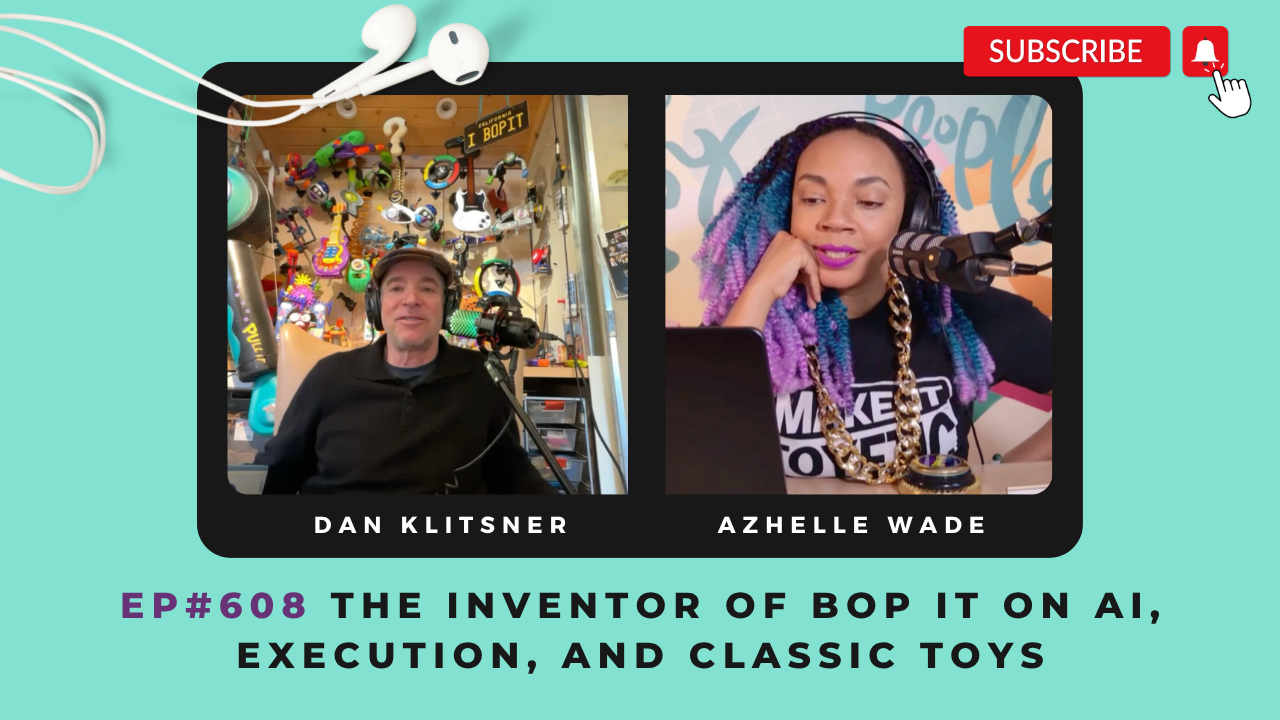
What if I told you Dan Klitsner discovered AI 30 years ago and used it to invent Bop It?
Well, he didn't. But I did ask Dan how AI might have influenced the creation of his hit game if it did exist when he was first starting out. Dan's breakout invention sold over 50 million units, and those numbers put the "song" associated with the game at Diamond status. (Dear music industry, he's still awaiting his plaque.)
This week on the podcast, I'm sharing a chat with Dan Klitsner, the inventor of Bop It. We talk about the upcoming 30 year anniversary, how he's been celebrating milestones over the years, and we dive into a chat about AI, execution, and what it really takes to create the next classic toy.
We get into how inventors can use AI as a tool, why execution can sometimes become the real invention, and what originality means in a world where ideas are easier than ever to generate.
If you're a toy inventor, designer, or product creator trying to figure out where AI fits into your process, this episode is for you, my friend!
Mentioned In This Episode
Connect with Dan Klitsner online:
https://www.linkedin.com/in/dan-klitsner-4b0bb52/
Learn more about Bop It For Good:
https://bopitforgood.com/
Have an idea for a toy or game? 🧸 Click here.
Do you have an idea for a toy or game that you think could be the next big thing? Join the Toy Creators Academy to learn how to bring your toy idea to life! Or book a 1:1 call with Azhelle to get personalized guidance on your toy journey.
Episode Transcript
Azhelle Wade: [00:00:00] oh, this idea is a match for something that you wrote in this note, it could alert you whenever it sees it. It could check every day, but also it could alert you every couple weeks or every quarter and say, you should touch base with this person to see if they've changed what they want.
that is something that we're even thinking about. But that is an admin use that inventors don't have time for. You're inventing, you don't have time to keep checking it.
You'll miss something.
Dan Klitsner: That's great. I'll take one.
Azhelle Wade: You are listening to Making It in The Toy Industry.
Season six, episode eight Hey there, toy people, Agel Wade here and welcome back to another episode of Making It In The Toy Industry. This is a weekly podcast brought to you by the toy coach.com.
today's guest is Dan Klitzner, an award-winning industrial designer and one of the most influential toy inventors of the past 30 [00:01:00] years. Dan founded Klitzner Industrial Design kid in 1990 and in 1997 created the game that changed play forever. And that game, my friends, is.
BOP it. Since then, Dan and his partners have created and licensed more than 250 game and toy inventions, including Popit Pro, hyper Dash Perplexes, and Simon Air. He's received multiple gold IDEA Awards and Toy of the Year Honors. Beyond invention, Dan has become a creative force on TikTok and a champion for inclusive play.
Dan is joining us on the podcast to celebrate 30 years of BOP it, and to help us explore what AI means for play and creativity in the future. Welcome Dan Klitzner.
Dan Klitzner: Wow. Thank you, Azhelle. That was an amazing
Dan Klitsner: introduction. I'm glad that's about me.
Azhelle Wade: I'd love for you to kick off by finishing the sentence for me. The thing that surprised me most about the toy industry was.
Dan Klitsner: how. Easy it was to get people excited about ideas and yet how hard it [00:02:00] was to get people excited about ideas.
in the beginning you're especially you don't know who are these people that are gonna be reviewing my ideas and telling you what they think?
really that is the feeling I have when I think back. That was the most, both of those were surprising to me or highs and lows I guess of both of those.
Azhelle Wade: So you came on this podcast back in January of 2022
Dan Klitsner: and you talked about how you can only sell an idea when it's right, RITE, can you say what those letters stand for? Yeah. It was something I've thought a lot about in that I think for many inventors, ideas are pretty easy
And the hardest thing is deciding
which one to focus on?
So RITE is knowing that you need relationship, idea, timing, and execution.
Azhelle Wade: before I hit record, you were like. When does execution actually become invention?
I thought this was such an interesting take on execution.
Dan Klitsner: Yeah, so [00:03:00] execution, if I gave 10 inventors the idea already and said we wanna do, X and they all did it, they might have, the same idea. It's not just the idea, it's how you execute it. And that execution then almost becomes the invention.
the etches sketch was thought of, however many years ago. But someone might come up with some new way of executing that and often when you're pitching something to a toy company, they'll cut you off and go, oh, we've already
Azhelle Wade: mm-hmm.
Dan Klitsner: So I think as an advocate for your own creativity, you can really turn things around. if you've done your research, you go, yep, I know you have.
it doesn't matter that an idea has been pitched. If you say to a toy company, let me show you why my innovative execution of it is the invention. This is what's gonna make that 2% difference. And being aware, being ready for it. Being ready for the well, we've thought of things like this and just knowing that's what your focus should be, is what makes this [00:04:00] different.
So it's execution becomes the invention at that point.
Azhelle Wade: That's so interesting. And I think it's a great conversation to open up to the industry, to open up to a relations reps that might be listening to be more more amendable, more open to the idea that execution can be the invention itself.
And then also for inventors listening to go into these meetings, understanding the value of their execution, and not to just glaze over the execution because it is so important. you said your job as an inventor is to pitch execution if you can.
Yeah.
Dan Klitsner: Pitch it if you can.
I wanna talk about this 30th year anniversary for bop It. Even though I know we covered this in episode one 10, just give me a brief what inspired the idea for bop It
Bop it was based on the simple idea that you want to. Animate the player. It's watch the kid, not the toy. It's this overall feeling of don't think of your product as what people are actually watching.
watch the player, not the game.
Azhelle Wade: the [00:05:00] game. Yeah,
Dan Klitsner: Watch the kid not the toy. for me it's been a nice mantra because you imagine, what are toy commercials?
The end goal is to make people laughing. I said a game of cards can be incredibly animating of people because what are they doing while they're playing? They're looking at each other. They're laying a card down, they're picking it up. It's very interactive, Just was a lay, a sort of a filter. I put over concepts, and at the time I was working on remote controls as an industrial designer for Mex, and I came up with this idea what if I did remote controls for kids?
so Mex wanted me to come up to remote controls and I said here, I had a whole series of them and one for kids. That was called the Channel Bopper,
Azhelle Wade: you bop to change channels. Channel Bopper meant bop, channel up, channel down, twist for volume up, volume down, pull for on, off. And that was your first Sam [00:06:00] prototype.
Dan Klitsner: so if you look in the video of me as a youngster,
this young kid pitching this as bop it and that is,
Azhelle Wade: I love the, obviously the traditional boppa design, but I actually really do like that one too.
Dan Klitsner: Tiger Games called and said, our LCD games, have really fallen off. Do you have any ideas?
And my first thought was what about that thing that used to be a remote control? Maybe that's a game.
Azhelle Wade: game.
Dan Klitsner: And so that same insight was thumbs. both of those things used thumbs,
Azhelle Wade: I told you beforehand that I had an idea and I wasn't sure if it's worth pitching. And I was like, before we hit record, I said I need a coach and then you coach me.
Thank you. And while you were describing like, does your product make you look at the product or the kid, I thought, oh, this idea I have does make you wanna look at the people playing. And then when you're just sharing your prototype, it just makes it feel so attainable.
Thank
Dan Klitsner: am very happy to coach the coach, but it's one of those, I say I, this [00:07:00] is the mantra. I share it a lot and I say, we even forget about it. And then, we'll be stuck. Brian and Gary and I will be working on stuff and I go, okay let's reel this back. What are the people
Azhelle Wade: Yeah.
Dan Klitsner: And in any game, go reverse engineer it from and that's a little bit how I approach invention is I almost first imagine,
kinda like Steve Martin or someone spoofing, or is there's a James Carey Skid at some point where he's mocking people that are, having this great time at a party.
And from one of his movies. I always imagine it's this idea like, yeah, that's what you want. You wanna have this, you wanna imagine what the people are doing and how they're laughing and what are they doing with each other and how they're interacting. And then you fill the toy in that makes them do
Azhelle Wade: Ah, it's so good.
Dan Klitsner:
It's the reverse of that. 'cause you know what you want the result to be. So don't, focus on gameplay and rules but what do you want the people to be doing?
Azhelle Wade: you can almost make a mood board of stock images of people having different expressions and just be like, this is our [00:08:00] vibe. Let's hone in on our vibe.
Dan Klitsner: ' cause some might be serious and stressful and some might be laughing.
when you test it with kids, you realize that when they put it down right away, often it's because it didn't really animate them in some way.
Azhelle Wade: 30 plus years ago, when you were pitching this, did you even know that you were going after a licensing deal?
Dan Klitsner: Yeah.I had already licensed five or six things I had a couple of games already that I'd pitched to and sold to Milton Bradley, Parker Brothers. I had stuff with Mattel. So I had been doing it for three or four years. But I still had clients that were industrial design clients.
I had a toy company discovery Toys. I was doing all their design as a freelancer. I was doing these remote controls. I was designing bottles, that's when I did the Clorox bottle. It's back there and the Woodford Reserve bottle. I was doing a lot of things and I wanted, I said, it'd be cool.
this licensing thing when it works is really fun. being able to pitch an idea and have a [00:09:00] company pay you a royalty on it was very different than my consulting work. But I liked doing all of them.
And in many ways I Was sorry to have to go full time on toy inventing because I really, for my design soul, I needed those projects where I was just designing.
this is mine. I'm proudest of Is the Pickle the new game from,
Azhelle Wade: Let's take Brief. Let's talk about the new
Dan Klitsner: This is a cute little pickle. This just came out with exploding kittens. And the game is called Pickle Grab.
Azhelle Wade: Pickle Grab
Dan Klitsner: this was, in many ways it fits my mantra, right? I'm creating a game where there's playing cards. And when the cards match, when two cards match, those two players are trying to be the first to grab the plate. And if so, they get to give the other, play their cards.
You're trying to get rid of your. If you get a card with a pickle on it,
everyone else tries to grab the plate, all the other players, and you're trying to grab the pickle. And if you do, you get to give your stack of cards out to the other players and vice versa.
So it's really simple, but like bop it I [00:10:00] think taught me,
make people make their own mistake. That's laugh at themselves, right? Bop it just tells you exactly what to do. And because of the muscle memory element where it says twist it, pull it, twist it, pull it, bop it, all of a sudden you twisted it because your mind is trying to make a pattern happen.
Azhelle Wade: Yeah.
Dan Klitsner: That's what the magic of it was. It isn't that, it's faster, but it's. There's something about your mind trying to make patterns. So what happens, this kind of game is similar where you have that, you get people used to grabbing the plate, grab the plate, then it's their
Azhelle Wade: pickle.
Dan Klitsner: And they grab the plate, and then they get all the cards.
Like it's one of those. And it's just creates that laughter, that moment of ah how I'm so stupid. How did I do that? Which is much better than so and so's just better than me. I don't like games where someone's just really good and they always win.
Azhelle Wade: I'd love to take a trip down memory lane with bop it. Do you remember what you did for the 10 year anniversary?
Dan Klitsner: I do,On the 10th year I [00:11:00] pitched an idea for a bop it with 10 things on it.
Azhelle Wade: Oh wait, was that the one with the flick? It
Dan Klitsner: no, I mean they never came out, but I pitched, I pitched this idea The one with the flick it the BPI Extreme back there was already out. It had been out in the, that was like the third year.
But I thought for tenure it's gotta be not just BPI Extreme, it's BPI Extremer or er
Azhelle Wade: bop it impossible.
Dan Klitsner: Yeah. So it was like, dumb and Dumber kind of thing. It was pop it streamer er, and and that was, I thought, this is it. And they, for many reasons it didn't get done. But that was what I was focusing on.
And then I don't think that much else happened because it was actually slipping a little around the 10 year mark.
Azhelle Wade: Interesting.
Dan Klitsner: but there's more. It's still there and there may be something coming. I'll just say that finally that has that quality to it.
Azhelle Wade: I think it was probably that they didn't wanna do a more expensive thing because when BOP it came out, it was, by the way, $20. [00:12:00] 30 years ago. That tells you something about how un inflationary, unfortunately the toy industry is. why we're losing profit is simply that we're not keeping up with inflation.
And BT Extreme was 25, which came out two years later in 99. Andit, outsold, mop it two to one, and it was more expensive because it had more stuff on it.And that's a thing about today everyone's no, it's gotta be $20.
it is such a shame that the toy industry doesn't keep up with inflation. People often say how even in times of recession families still spend on their kids. However, as an industry, We're very afraid of high price point and selling less.
Dan Klitsner: Don't get me
Azhelle Wade: Oh, okay.
Dan Klitsner: bop it 20 years in, what did you do for that anniversary
20 years in, it was actually whenwe had been working on a lot more interactive stuff and the idea of connecting to think of it as bop it as a controller for your
Right? And so there was a big pitch. Was [00:13:00] this bop it interactive idea that was showing that I thought we were gonna go into connecting the BPI to media.
And I still think that, and maybe it'll still happen, but I'm I think I've shared this on my social media before. Partly I share a lot of the BOP things. 'cause after 30 years, we've thought of a few other BOP
Azhelle Wade: Yeah.
Dan Klitsner: And I get an awful lot of people saying, Hey, I have this amazing idea of what you should do with Bop it.
And I go, Uhhuh, I don't mean to be arrogant, but I don't really know how far it's gonna be off. And almost this kind of idea comes up. A lot of things come up and you're like, yeah, there's a lot you can do with bop. Believe me, we've tried. The reason they don't get made isn't 'cause they're not good ideas.
It's just whatever those reasons are. in this case, we really thought for the 20th that it was elevating it towards this much more tech. Adding in the idea of a video game controller that you can control bringing, bop it into the virtual world which we are actually [00:14:00] doing now.
There's some products I have out, but, so that was what the 20th
Azhelle Wade: we like to be a little like 10 years or so behind the,
Dan Klitsner: years.
Azhelle Wade: we like to ease in, to change.
Dan Klitsner: But that, it wasn't so much the 20th, it was the 25th that then I really got a head start on. And personally just because it was, it's hard. Toy companies can't always do anniversaries. they say they're 50 50 on whether customers care about the anniversaries.
And so personally for the 25th, that's when the pandemic was hitting. And I really went in on this. I wanted to do a product that was a give back, and that's when I did the bop it button,
Azhelle Wade: Oh, this,
Dan Klitsner: personally did. Yes, the button was done for the 25th. Yes.
Azhelle Wade: I did pretty decent my first time
Dan Klitsner: that's
Azhelle Wade: three. Okay.
Dan Klitsner: so that it says bop it and don't bop it.
It's a one button bop. I wanted to do something that celebrated. The people that helped me make Bopt, Hasbro and Milton Bradley, I wanted to honor and thank them. I wanted to [00:15:00] do something for the fans who had supported all these years somewhere to interact and bring them in.
And I wanted to do something for a cause to give back. And so that the cause was Lighthouse for the Blind. It was because so many people who are blind are, BPI has become one of the biggest games for people who are blind. Because you can play it with no, yeah, with no, if you look it up, it's one of those incredible, so it's bpi with the blind community is big because you can play it just as well
Azhelle Wade: Wow.
Dan Klitsner: with scene or no scene.
It's, you can, you know where the controls are and it's an audio-based product, and it's not just that you can play it. What it did was it allowed families to play together with their, you might have a blind sibling
Azhelle Wade: it's all,
Dan Klitsner: children or parent, whatever it is in your family. Now you've got this game you can laugh at and play and pass.
And when you watch people play, you don't know who's blind. It's like, it not only solves the interaction between the people, but [00:16:00] the people watching you, you don't, it takes away, it's the stigma. It does everything. so this product was to raise money, but also every time you bought one of those, we gave one to Lighthouse to the Blind, not just to use, but they have a store.
So then they could sell these bop it buttons as a way to, to make then, and they would make the full amount. So if they were $20, you buy one for $20 from me, by not making profit, I can afford to give you one and make another one so I don't go backwards.
Azhelle Wade: I didn't know you actually sold these. I thought you were just making these and hand 'em out to your friends.
Dan Klitsner: No. we didn't do big marketing,
Azhelle Wade: it's sold and you can buy it through Lighthouse for the Blind because they have an accessibility store. they make the full $20 when they sell
Dan Klitsner: And so when you buy one from, for $20 from me, it made them the $20. It was a weird sort of perpetual motion machine business model. I was more proud of the invention of that business model than of the invention itself. [00:17:00] And it really inspired me to think the whole product.
And it was in a box with, I think you can see, if you see the
Azhelle Wade: Oh, I'm looking at it right now.
Dan Klitsner: all the names of all the people. I could think of the a hundred people that were part of the history of bop that,
I drew everything. I just, it was really a personal feeling. That's why it's all sketched. it's a one button no on off switch. and thank the fans.
I did an audition on TikTok where you had to say, I remember my first time playing bop it. And you had to say a few things. And then we posted them all, and people would whoever had the most likes, the 10 people that had the most likes got their voice in this bop
Azhelle Wade: Wow.
Dan Klitsner: And then when you play it, even though it's one button, it says Bop, it don't bop, it bop it don't bop it bop, don't bop it.
it's one command, but it's really
Azhelle Wade: really clever.
Dan Klitsner: It's really fun. then every hundred bops, it would unlock another of those voices.
Azhelle Wade: getting,
Dan Klitsner: A lot of people have done thousands of bops.
Azhelle Wade: get to 10. I have to get to,
Dan Klitsner: you'll [00:18:00] start to, and my father's in there who is influential on my life and on my voice is in there.
Myoriginal industrial designers in there, so you can unlock all these TikTok people in there. And so it's, it was completely a product meant as a give back and a gratitude
Azhelle Wade: so they didn't all come with this gold chain necklace,
Dan Klitsner: the gold chain was afterwards. I did that later that year. And I gave it because the I had one sort of, as a joke and one of the people who blind this guy that is amazing. He's a tour guide in San Francisco,
And so I gave him this so he could wear it while he walked and play while he
Azhelle Wade: yeah,
Dan Klitsner: And then I thought, this is cool. so then I had these made
they're very handy to just be able to have unlimited gold chains to give to people
Azhelle Wade: funny. So did you have to work with Hasbro in doing this,
Dan Klitsner: I just got, I worked with actually Super Impulse is the license. they came out with it in their market. Super Impulse
Azhelle Wade: so this is a separate category than what you licensed to [00:19:00] Hasbro?
Dan Klitsner: no, it's the same category, but there's out-licensing of brands.
the brand is out licensed via hobo.
Azhelle Wade: I see.
Dan Klitsner: To be used, not sold by the core group,
Azhelle Wade: Yeah. The world's smallest is a brand they license the products. When you see the mini Jenga and, world's smallest key chain versions of things, that's not Hasbro making them it's super impulse or basic fund or one of these companies licenses those brands and then manufactures them and pays Hasbro license
Yeah,
Dan Klitsner: how that happens.
I know.when you said that they got the whole $20, I was like, how are they getting that with the invention fees and all that stuff is Because I took it on and I sub licensed the brand.
Azhelle Wade: That's what I was wondering.
Dan Klitsner: because I'm the manufacturer of that product,
Azhelle Wade: Ah.
Dan Klitsner: I can do it that way.
Azhelle Wade: It was very different than
Oh, that's so great. this is really cool that you did this for the 25th and Okay. I do have to say though, when I was asking what did you do for the 10th and the 20th and the 25th, aside from like professionally, I wanna know how you [00:20:00] celebrated.
Did you personally go and celebrate and take yourself out for
Dan Klitsner: I think I celebrate by trying to make something. I guess I love creating things and so yeah, I focus on what did I do? My first thought for celebrating the 25th, was I was like, I wanna make something and show people my gratitude,
Azhelle Wade: nice.
Dan Klitsner: I'm just so grateful.
It's, I worked extremely hard, I think, but IYou need to show your gratitude. I'm so proud of that BOP button It was so much fun to work on
I couldn't have celebrated any, in any way. That was more meaningful to me.
that button has so many things that weren't necessary. But I spent a year just going, I just don't wanna, I just want to keep going and make all these little tricks and things you can discover the more you play with it. use gratitude as your I don't know, your goal more than sales.
I just saw the new CEO of Kickstarter speak this weekend at an event. he said, they turned the company around.
It was failing a few years ago. And he did it by saying, I focused on impact, not on [00:21:00] profit,
Like the creators, how to make them better, how to do that. He really believed in that and it totally worked. And so I feel that's a model we can all learn from,
Azhelle Wade: I have been learning this. I think my impact started off being the focus and then it just became a result of my work. And the last two years I need to make sure that all the decisions are how do I help my people, get their products out and sold and
They need this. This is what will help
Is what will make an impact on them and the industry. Yeah.
Dan Klitsner: that's a great example.
Azhelle Wade: Put that filter on what's the most impactful to People. and it's amazing that they just have faith that will result in, people feel it, they feel it in the product.
Dan Klitsner: But more importantly, you feel it while you're inventing or designing. It's more exciting. You're more motivated. It's a hard industry. It keeps you knowing you have a
Azhelle Wade: Yes. Okay. We're here at 30 years with bop it. What special partnership events, promos do you have planned this year. What can you tell [00:22:00] me?
Dan Klitsner: this isn't the 30th year.
Azhelle Wade: I knew you were gonna say that. I was like, what is he gonna say
Dan Klitsner: I credit 95 is the year I invented it. That's when the video was made. 96 was whenThe name was trademarked. It was my name, but when HaBO trademarked it, that's what all the paperwork shows.
So it looks like it was patent applied for whatever it was 96. But it really, I was there, it was launched in February of 1997. In New York, and it was not sold until July of 1997. So I don't understand the 96 being the date,
So we're getting a headstart it on the 30th year and it's good. This is when all the planning is happening. And there's a few things in the works personally. II'm trying to finish the book that I started for the 25th,
Azhelle Wade: So I was working on this book with deed from Mojo Nation who did this amazing set of articles on me. we covered so much of the [00:23:00] BOP history that it was two full. Articles and we said, Hey, this is almost a book.
Dan Klitsner: And we said let's just do it as a book. So I actually started working on this book called Take This Book and Bop it and I said, but I wanna have a working bop it on the front of it. So I got sidetracked working on that bop it
Azhelle Wade: Oh,
Dan Klitsner: and that was meant to go on the front of the book.
And then as I got into it, I was like, I got so into the button. I said I think I'm just gonna do the button for the 25th. Not this book.
Azhelle Wade: so I got sidetracked on the BOP button. Then I thought, I'm just gonna do this, which I did, and it was really a cool way to celebrate. But we still have the book, so we are actively looking at trying to get it out, by maybe end of this year, beginning of next year, truly in the 30th.
Dan Klitsner: So that's my real, one of my main goals.
Azhelle Wade: man, of all of the versions of Bop it over the years, which one makes you smile the most?
Dan Klitsner: I think definitely the original,
Azhelle Wade: yeah,
Dan Klitsner: The one that looks like that here, watch this trick.
Azhelle Wade: He's lining up his actual bop with his [00:24:00] giant. How big is that? Bopt?
Dan Klitsner: It's about
Azhelle Wade: Wow. It's as tall as
Dan Klitsner: but it was,the first time I met you I was like, you're so much smaller than I thought you were
Azhelle Wade: Everybody says that.
Dan Klitsner: but this was the one that, was from the first toy fair. But yeah, the reason I love this one the most is not just 'cause it was the first one, but I just think the elegance of three things and the weight of itjust the sounds twist it, and that's.
Azhelle Wade: oh yeah.
Dan Klitsner: scream, the way it counts is
like it was done with six seconds of sound.
Azhelle Wade: Wow.
Dan Klitsner: And it was just so elegant and it just focused on just the Bob Welch from Parker Brothers at the time was brilliant industrial designer who did this final design.
if you're listening to this episode, he's holding up the Bopt remote Control first mockup against the final Bop it product.
and here's the twist. The twist went to the top, the hammer. it's really a hammer. Like it's such a cool transition between them. But I would [00:25:00] never have come up with this beautiful, which I think should be in the Museum of Modern Art.
This first Buppet is so beautiful, elegant, it epitomized everything I wanted to do it. It made the player move, but it also was a beautiful kind of object. It's more of a, compared to a lot of toys, it really had an elegance to it and very three dimensional. So I just, even though I love all the others, this is just to me, so classic.
Azhelle Wade: Bop It is a clear professional achievement, but is there something unexpected personally that it brought to your life?
Dan Klitsner: it's hard for me to separate them because I like to say I retired, 30 years ago, but now I have a great hobby, I, I feel. If I wasn't doing this, there's no way for me to separate what professional and personal is. 'cause I love playing games.
If you come to my house, I'll make you play, game nights, all that kind of stuff. So it's all been my world, however personally, I love how it's connected me to being able to [00:26:00] relate to people who've played it, who I never knew. And they meet me and they say, oh, and I say tell me the story.
it's just such a cool feeling that I can hear this story of someone I never knew 20 years ago and they had this whole memory with their family or their brother or someone. And they tell me about it and it's like I'm connected somehow to them. Like I created something that, it just makes me feel so good.
And so it's a feeling of impact, it is true that some memory stuck in them, and that's really, one of the more amazing feelings if you invent, bring something into the world that other people who you don't know use or play with,
There's so many people to think as to how this product became successful, but I feel like I was the one I'd like to say who threw the pebble in the middle of the pond.
The ripples started and those ripples are still going and that feeling like, I dunno quite how to explain that feeling, but the other thing it allowed was
it did let [00:27:00] me have some breathing room to then focus on more invention
it did focus me on that and obviously let us have a company that had a little breathing room so we were able to work on other risky things.
Azhelle Wade: I've realized in my life I have quite good hand-eye coordination and now I'm wondering if some of that I should attribute to bop it.
Dan Klitsner: Oh, you should, absolutely,
Azhelle Wade: I had such practice. Oh my gosh. Congratulations on close to 30 years
I would love to transition into a short conversation about AI if you have some time.
Dan Klitsner: Absolutely.
Azhelle Wade: So when you first started and you were inventing, AI was not a thing. Have you ever thought what would've been different if you had AI at the time that you were inventing BopIt?
Dan Klitsner: I better admit something here. I'm actually the only person that had AI 30 years
that's how bop it was invented. Okay. I've said it.
news. why do you think it's just training humans to do what it says?
it's taught us to do what it says.
Do you think that AI would've impacted [00:28:00] your development process, your invention process?
I am like everyone just shaking my head at what is, we're in the future now.
Azhelle Wade: it's
Dan Klitsner: clearly a powerful life changing tool, world changing. But,
I'm old enough to know that when I was in design school, I did not have a computer. I learned to draw really well.
Azhelle Wade: I love drawing. I love building. I still go into the shop and build with foam cord when I'm thinking about ideas.
Dan Klitsner: I love doing things with my hands. But on the other hand, I love innovative new technologies and I am pretty excited about the things you can do with ai.
So I can't say, would it have changed? it may have, but my own personal, excitement about design and invention is the building itself and making of things.
I love the process of working on it and building things and making things. So I am seeing great things with 3D printing and AI and all that stuff, which is [00:29:00] coming. I think the part that's the most impactful about it for us is the ability to do sizzles or video or presentations or visuals that are in my head that I wanna get out there.
But it's a hard process to do a high quality video with narration and all this, and that's what we're doing more, just starting, go, wow this makes it possible for us to take what's in our head and get it presented to others.
Azhelle Wade: Can you gimme an example of one scene that maybe you in the past would've said, I would love to do that, but it's not worth it. Let's just talk it through in the pitch. Whereas now you're experimenting, you're like, oh, we could render this the way I'm
Dan Klitsner: I think rendering for sure,
I don't have enough hours in the day to do what I wanna do. And so to be able to, rather than having to communicate to someone the fact that I can prompt something, really work on getting the visual that I want, or it's my idea still, but I'm just helping it, help present it.
Taking away a lot of the hours of where I might have hand [00:30:00] illustrated something or 3D modeled it. But it's also the video part is, the part I think is really amazing is, for instance, we have a game, a product I've pitched a few times in renderings that people really like. They're like, can you prove that this works?
It's got some technology in it. I'm like we know the technology exists. So we know it can work, but I don't want to spend the money to prototype it.
all of a sudden I can make it look like the product
Azhelle Wade: Yeah.
Dan Klitsner: and really get people to get excited about it, knowing we know this product is possible to make, but until you see how it's gonna be sold, it might not be worth a company investing.
So I think you have to pick the right idea that sort of, if it looks like something that's impossible, then what good is it? But when it's something that's obvious, how it would be made,
And now you can just do something that, that gets a big idea out there to share.
Azhelle Wade: This is a good thing I haven't thought about with ai, because we are so far behind in inflation, we don't raise our prices often. We wanna maintain our margins. People are very hesitant to invest in [00:31:00] things that are really new and different, or require heavy molding, heavy tooling.
So AI as a presentation tool, as a sizzle creation tool, can help us sell concepts that otherwise people wouldn't wanna take a risk on, and could actually thereby improve the products that are coming out of toy companies, maybe even increase the price points to help us sell more products.
I hadn't thought about that angle. That's a good point.
Dan Klitsner: It could, you're getting the tools, like when Photoshop or these kind of things came out for me, or 3D modeling at all, all of that came out, you first thought was, wow, there's just eliminated
Azhelle Wade: Mm-hmm.
Dan Klitsner: yet now as the AI jockeys are the new job
As an illustrator, part of how I was able to survive in my early days as a freelancer was I could draw really well. So architects would hire me to draw their designs and I could charge them a pretty good rate for that. And because I was a designer, I had a good eye
[00:32:00] you had to make it look good, make them look good.
I think it's the same with ai. You could be a good AI jockey who knows how to say things, but if you don't have the judgment, from your prompts of what it's producing, you go, Hey, it looks good to me. Then it's just gonna be a bunch of good looking, crap. Instead of,
Azhelle Wade: I.
Dan Klitsner: I have years of experience with this, so now I can use that tool to create a sizzle that I think really says what I wanna say, and I can finally convey this concept that was really hard to get people excited about
Azhelle Wade: that's a very good point because whenever I'm teaching someone new how to use ai, if we're on a coaching call, I'll say, okay,
If you are not giving it specific guidelines and you're just giving it a general concept, what it outputs is gonna be made of a bunch of stuff that already exists.
you're right. It's, that's what's gonna be the fallout of it, is it's just like any medium. my advice to people in. Invention or school or anywhere who wanna be in design or invention is just really master those tools because the [00:33:00] ability,
Dan Klitsner: one of my strengths coming out of college was I could present my ideas so well with my drawings and my skills.
That was the philosophy of art Center was you're gonna have great ideas, but how are you gonna communicate
So this is a pretty big step Now. You really don't have an excuse not to be able to communicate your idea.
Azhelle Wade: yes. Do you think AI will change, not just how we design games, but also how we play with games?
Dan Klitsner: I'm counting on it. Let me just say without
Azhelle Wade: Ooh. Now my next question. What's a gameplay experience you might imagine bop. It could have with ai? Huh?
I
Dan Klitsner: I think we're all imagining a lot of similar things I think it's already been spoofed so much as an AI character.
Azhelle Wade: If you look on TikTok at the thousand or so, spoofs I actually was in a skit that someone did as if Bop it was, had AI in it. And this was three or four years
Dan Klitsner: ago,
Azhelle Wade: so
Dan Klitsner: there was a skit. They did a whole film on. It's pretty funny. And, there was a parachuting one where the guy [00:34:00] bop skydives or the bop it, and then the day after we did a, we did this thing, is it called?
there's been many things like that. And I see tiktoks all the time where people are pretending that the BPI is saying other things, that it knows you. So clearly that's not, it's, that's great as a concept.
What do you do with the, what is, what happens next? because Boit is such an audio-based product that has a voice that talks to you. It's pretty ripe for that. I'm more interested in. What's a brand new thing?
What's the next bpi that isn't at all a bpi, that's something that you could only have done with ai. The iconic, I think of games like Pictionary and the classic games that sort of created white space. Any of the classic Hasbro games, Jenga or the risk or monopoly or everywhere.
When you name these iconic things,
the real question is can you create something so iconic that's never existed before. That's the white space. That will become a classic.
Azhelle Wade: Yes. Have [00:35:00] you personally experimented with AI tools like generative design or video editing when you're doing your prototyping or your pitch prep?
Dan Klitsner: Yeah, and I'm starting to less on ideation.
More on the presentation, but there is a little bit of, prompting make this, make that it's amazing, to be able to do it.
So what's weird about AI is it's in the middle there where if you can think of it, it's gonna tell you things that don't exist, but are similar to things that
I think you need to use both. Then going back to does this exist already? And just 'cause you don't see it on Google doesn't mean toy companies haven't tried it
Azhelle Wade: I built this AI tool to help test out different game mechanics on a game. And then I wanted it to do the research to see if there were similar games. So I have it set so that it will help you do the mechanics research, but when you finalize on an idea, it tells you what games are similar and gives you a link to them so you can like, make sure it's 'cause we can't trust AI because
Dan Klitsner: use. Yeah.
Azhelle Wade: [00:36:00] I know,
Dan Klitsner: Uh, although if it really gives you links where it works, 'cause there's some
Azhelle Wade: I know. That's why I made it give Yeah
Dan Klitsner: you're
Azhelle Wade: That's why I made it give links. I was like, you have to cite everything that you say already exists. Because I tested a couple times and Actually, it showed me games.
I didn't know
Dan Klitsner: what's useful about that is that execution
you will find almost always something similar. Don't be afraid of
it. Make sure you know what it is and say, yes, I've done my research. Here's what's been done. This one didn't succeed. This one did a little better, but here's why mine will.
Azhelle Wade: It says your game is similar to this, and it'll say, but what's different is this. So I'm like, it's so good. I have to test it like a hundred more times to make sure it works consistently.
some people are afraid that AI is gonna replace humans and human creativity. Other people are just thinking it's gonna amplify it. Since you've lived the life of being a successful inventor without ai, I wanna know what you think about the introduction of [00:37:00] AI into the toy or game invention process,
Dan Klitsner: Yeah it excites me and scares
It's excited by, as I said, I always feel I have too many ideas and being able to iterate quickly in the little work I've done. when I first was shown chat GBT three years ago,
Azhelle Wade: my son shows me this. And I'm like, whoa, what is this new thing? so I said, all right, let me try this. And I put in the sentence, make a game show that combines bup with American Ninja Warrior.
And it was all your work
Dan Klitsner: It pretty much 90% of it was exactly my
Azhelle Wade: Oh my gosh, no,
Dan Klitsner: where things I thought were so creative and it really shook me. I was wait a minute, am I even creative? Is that all creativity is it just mixing logical things together and coming up with the most obvious solution?
Azhelle Wade: But here's my argument again for this is I think this will take us as a society to level up to the next thing. 'cause now combining those two things is like our base starting point, right? So now it's like, all right, [00:38:00] maybe it's American Ninja, warrior bop it, sixties retro
Dan Klitsner: you're right, you can mash up and the nice thing is you could just take a quick glance at a version of what that might be.
Azhelle Wade: I think that's really fantastic. The exciting part, but the scary part is a little bit that it feels like it's gonna. I'm groaning at all the things that we're gonna see that are people that don't, they just come out of the blue with something that they chat g Btd or whatever, some new idea.
Dan Klitsner: and maybe that's what it'll net out, is that, yeah, you'll find out that it's like this powerful ideation tool, but that, hopefully. Your the what becomes original thinking. Might be elevated where you gotta really outthink
because of what, that's what it felt like is that when I came up with a few things, I go can I come up with an idea that AI doesn't come up with when I give it a prompt that's similar?
if all I'm coming up with are things that it's gonna come up with, everyone else can do the
it may be a way to test your idea against even more than Googling [00:39:00] the most obvious of
things. But on the other hand, sometimes the most obvious is what you should be doing.
Azhelle Wade: this is actually a full circle moment back to your first comment about execution. Because another thing that will happen in this era is everyone will be prompting new ideas. I find even with myself, because of ai, have so many ideas of where I wanna do what I wanna do with my business, where I wanna take things, but what can you actually execute and what will you actually execute that's gonna differentiate who is the next big game inventor versus who's just the person who has a bunch of ideas that they're pitching,
It, like AI might be here and everyone might be using it to synthesize a bunch of ideas, but the people that are executing on those ideas, I think are the people that are gonna go far.
Dan Klitsner: Yeah. And making the choice, the RITE,
maybe I'll update that with ai. maybe I can use AI to give me that thing where I'm saying, do you have the relationships for this particular idea to
Azhelle Wade: is the idea as strong as it can be, is the timing.
Dan Klitsner: That's [00:40:00] relationship, idea, timing, execution. Maybe that has to be put into, something to help you evaluate whether an idea is ripe
Azhelle Wade: that ultimately what you just said there is the hardest thing of toys or any business, especially entrepreneurs and ideas, is which one are you gonna, you only have so much time and resources, what are you gonna spend your time on?
now you can have a conversation with a company and get an idea of what they're looking for. Jot down a couple of notes. Have a spreadsheet in your Google account that's connected to Google, Gemini's ai.
And you could put in your ideas and be like, which company should I pitch these ideas to? And it could search through your notes and your ideas and say, this is best for this company because, and that would save you a day's of thinking and planning and possibly missing things because we're human, we're fallible, we might miss things.
Or just double checking did I, am I pitching this to everyone? I should. These are the conversations I had this week. Who else should I pitch this to?
Dan Klitsner: I think you usually ask, [00:41:00] what's the best advice you could give?
Azhelle Wade: Yeah.
Dan Klitsner: And a lot of that is the number one,
When you're, every time you pitch an idea, you're not really just pitching the idea, you're building a relationship with that person, It's how you know them and that you are, understanding what their business, what they need. You're gonna get an idea during that pitch that you might use years later. But what you're saying is, can use AI to help you remember or quantify all that stuff ' cause the hardest thing is having an idea that was the right idea at the right
Azhelle Wade: And you didn't know.
Dan Klitsner: right execution.
And I the wrong person.
I did not pitch it to the right
Azhelle Wade: Yes. And you know what you just made me realize. So all the tools, like all the project management tools now have AI built into them. So I use clickup and they have AI agents built into them.
So you could say keep an eye on this, and if this happens, do this, do X, Y, Z. So one thing that I think would be helpful is if you had, let's say, like a imagine a table in your project management. Form internally that [00:42:00] you would keep notes from all your meetings with the toy companies you have relationships with and who that inventor relations person is.
And then not only do you periodically have the agent look at that list and look at your list of ideas and tell you, oh, this idea is a match for something that you wrote in this note, it could alert you whenever it sees it. It could check every day, but also it could alert you every couple weeks or every quarter and say, you should touch base with this person to see if they've changed what they want.
And then you update your notes and it could continue and check for you and say, this idea like that is something that we're even thinking about. But that is an admin use that inventors don't have time for. You're inventing, you don't have time to keep checking it.
You'll miss something.
Dan Klitsner: That's great. I'll take one.
Azhelle Wade: Yeah, I'll take one. Add to cart. Alright. Closing questions. Dan, what are you hoping to achieve one year from now, whether it's personally or with your invention? Business and studio. Or bop it?
Dan Klitsner: I think my goal for the year, [00:43:00] it's when I started with Sling It and really what I started with the Popit button is, I think as things have changed, and I, I dip my toe in the social media clearly in the pandemic like many people, and was really so many positives about it, where.
I made all these relationships, but through the inventor of BopIt, maybe it opened more doors to other creators who were really interesting, right? And so I, and the collaborations I did were so fun, but I stopped because I wasn't getting enough of my invention, new ideas done, which I love to do.
So if pe people have noticed, there's been very few posts, I'd love to get that back up because of all the interaction, but also I think my real goal is to, at this stage in my life and hobby, is to have more time more products that I just come up with that I can sell direct to consumer through
Azhelle Wade: Oh,
Dan Klitsner: shop
My ultimate goal is a year from now, I'd love to have that. Working
So I'd love to try some more direct to consumer [00:44:00] product through social media.
Azhelle Wade: Oh, that sounds great. we can end with this. What toy or game blew your mind as a kid?
Dan Klitsner: I think I have to cite Mouse trap.
Azhelle Wade: Really you're
Dan Klitsner: the most in influential of any game or product? I just loved everything about it.
Azhelle Wade: of three interviews this season. You were the second to say mousetrap.
Dan Klitsner: Is that Yeah. it was, and he just passed away.
Azhelle Wade: Oh.
Dan Klitsner: It was just I think the fantasy of it and the industrial design of it and the humor and if you think about it, it's just it represents that three dimensional, physical experience that I clearly, have gravitated towards.
And yeah, just the excitement. I can still feel what it was like, building it with my brother and sister and doing it. I was more game, very game focused, less toy, I collected Hot Wheels and did all that kind of stuff. But in terms of mind blowing, I don't know about, yeah.
Probably close to me. [00:45:00] Just the love of that product.
Azhelle Wade: Oh.
Dan Klitsner: I do remember when BOP it was successful and I saw the box or the logo and it said Milton Bradley. I remember just, tearing up just oh my God, I, I can't believe it. I have one of those games, like the ones that, as a kid I could never imagine this
Azhelle Wade: full
Dan Klitsner: circle for me, it was like, wow, I did this.
Dan, it's been 30 years since Bopit launched. when you reflect on those three decades, what has surprised you most about the game's? Cultural staying power.
Without doubt the thing that's blown me away the most isthe media, has shown how it's affected pop culture, it's been spooked on Saturday Live at least two or three times, it's been in all sorts of the Simpsons episode, which I'm so honored to have been spoofed by the
Simpsons. But the biggest one is really if you search Spotify, there are close to a hundred songs now [00:46:00] named Bop It, that are not just riffs or excerpts from mashups of the sounds. They literally, if you put in the word bop it in search on Spotify, you're gonna see a lot of songs called, these are just the ones called Bop.
It, these are not, there's hundreds more that have bop it references in them and sounds, and it's crazy. Like look at the album covers, look at the
Azhelle Wade: Yeah.
Dan Klitsner: the words and the lyrics. They're taking all these riffs off of the word bop it. Yeah, you're seeing some of that now.
There's, and Lizzo just did one a few months ago called Bop It, she has a new song in her new album
And she starts the song off with bop it, twist it, pull it, talk about blow away wow, this thing, how did this happen? And so Rolling Stone did an article on me last year.
They had seen something I talked about this thing with music and they asked the question in this article, if, what's the most nostalgic song of the nineties? [00:47:00] The answer may surprise you. And they compared the amount of sales because products used to be sold or album.
The way they measured singles or albums was how many you sold? That was a gold record. A million was platinum. More than a million albums sold was multi-platinum. And then there was this thing called Diamond, which is, I believe 10 million sold of an album. And really you'd think, you don't realize, besides The Beatles and Led Zeppelin, and Mariah Carey and Michael Jackson, there aren't that many.
And they said, actually in 1997. Bop it would've been considered a diamond record for the amount of sales, because it's a song with lyric original lyrics.
Azhelle Wade: talk about influence that people use it in, in, not just in songs, but of course they'll make some joke. They'll, comedians are doing some joke and they'll say, oh. I'm not only gonna, take it, I'm gonna bop it and pull it too, or whatever. They'll, the, it's used a lot and by some pretty [00:48:00] well-known comedians.
Dan Klitsner: So every time I see that it is just, I can't even really absorb it.
the fact that you played the toy and it made this music happens like a song that you experienced with friends that's nostalgic. it got into you in a way even more than a song does. It's like when you dance to a song, you remember it a little differently than when you just listened to a song and I think bop it gets into people because you are physically doing it while this music and this rhythm is getting inside of you.
So that's, I believe, part of why it stuck. And the third thing was humor, right? The fact that it had this humorous quality to it. We all know that humor is something that sticks in people. You'll remember what a funny moment, right? Or some of the biggest memories you have. You'll remember that moment and the nostalgia from that moment.
you think of the most surprising thing, how no one could have predicted it and at 30 years, it's part of pop culture
Dan, thank you so much for celebrating this milestone with us.
Azhelle Wade: There are some other things to [00:49:00] celebrate the 30th I cannot reveal yet, but hopefully we can revisit those next when they do come
Listener. If you love this podcast and you haven't yet left us a review, what are you waiting for? Your reviews keep me an amazing guest, like the inventor of Bop Dan Klitzner coming back week after week, season after season, and every time a new review comes in, I get notified, puts a huge smile on my face. If you wanna connect with Dan on TikTok, look him up at Bop it Inventor and check out his website.
Bop it for good.com. All of the links will be in the show notes of today's episode. You can go to the toy coach.com/ 3 0 8 to get those show notes. If you enjoyed this interview, you're definitely gonna wanna tune into next season so you can hear some of the bits we pulled out talking about sales and revenue in the toy industry.
As always, thank you so much for spending this time with us today. I know your time is valuable and that there are other podcasts out there, so it truly means the world to me that you tune into this one. Until next time, I'll see you later to people. [00:50:00]