
S6E01 | The Hidden Cost of AI In The Toy Industry
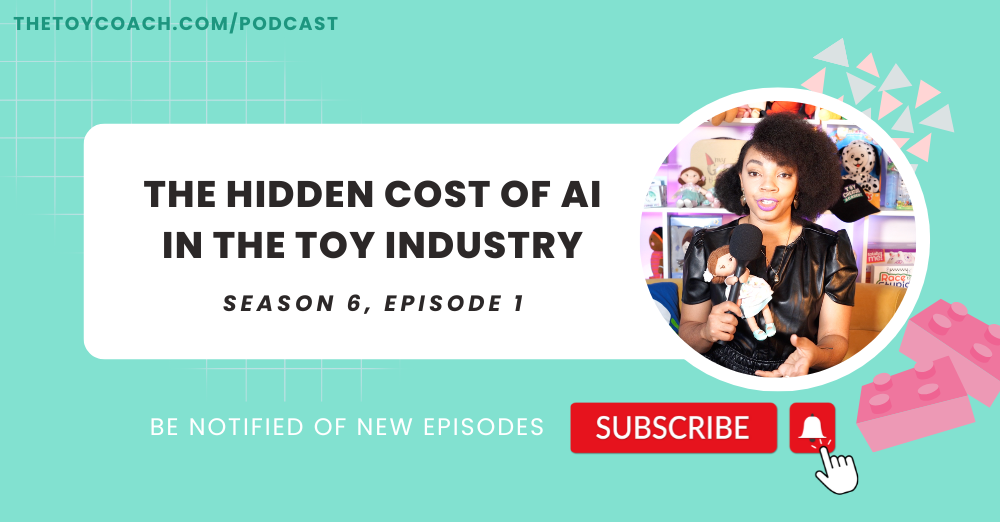
With every major advancement in science or technology, there is bound to be pushback. AI is no exception. This season is for toy and game creators navigating AI in the toy industry. In 10 episodes we’ll explore how to use AI while maintaining your taste, trusting your judgement, protecting your IP, and actually saving time.
This first episode is the foundation for the coming weeks. Before you dive any deeper into AI, let’s get real about the risks of operating it with little to no guardrails.
In this episode, we’ll talk about:
digital amnesia
the environmental impact of AI
the hidden ways AI is already showing up inside your tool stack
AI use cases that dull your brain and personality
Season 6 begins now.
About My NEW Podcast Art:
The podcast art for Season 6 of Making It In The Toy Industry features product illustrations of toys and games I helped guide in Toy Creators Academy and TCA Accelerator. Tap the brand name below to check them out!
Playcor by Courtney Smithee
9 to 5 Warriors by Brandon Braswell
Catoms by Kieche O'Connell
The Lunch Room by EAP Toys and Games founder, Chrissy Fagerholt
-
Articles and Videos Referenced:
https://www.businessinsider.com/chatgpt-by-the-numbers-2025-11
https://www.axios.com/local/des-moines/2026/01/16/microsoft-west-des-moines-data-center-water-zero
https://www.theguardian.com/technology/2026/jan/13/trump-microsoft-data-centers-electricity
https://www.theguardian.com/environment/2024/sep/20/three-mile-island-nuclear-plant-reopen-microsoft
https://www.nea.org/professional-excellence/student-engagement/tools-tips/environmental-impact-ai
https://www.csofutures.com/news/data-centres-could-consume-12-of-us-electricity-within-4-years/
https://news.mit.edu/2025/explained-generative-ai-environmental-impact-0117
https://news.mit.edu/2025/explained-generative-ai-environmental-impact-0117
-
Azhelle Wade: AI already knows a lot about you, but most creators still know surprisingly little about it.
While you're still using Chat GPT to write LinkedIn posts or reply to emails, serious creators are activating AI agents and custom GPT to save hours of work and increase their value in this industry. This season of making it in the toy industry, we are studying, critiquing, and mastering the AI tools that actually matter.
The good, the bad, and the UI ugly.
This is making it in the toy industry, the show for creators, building scalable brands and businesses in play. I'm your host, Azhelle Wade.
Hey there toy people to kick things off this season, we need to address the elephant in the room around ai. Now, if you've been resistant to using AI tools in your toy business, or if you've started but quickly quit feeling overwhelmed, then listen up. This episode is [00:01:00] designed for you for people who feel uneasy and unsure about ai.
It's also for those of us that have a love hate relationship with ai, self included. I made this episode for both me and you. I've used this tool in my business openly, but of course it doesn't come without some risk. So in this episode, we are going to break down what risks AI poses to our environment, our minds, our businesses, and our toy careers.
By the end of this episode, you're gonna understand the impact of ai. It's best use and worst use cases, so you can choose to use it in a way that doesn't feel reckless or unethical, or out of control, or totally opt out.
So first up, I wanna talk about why this fear makes sense first. No one in the toy industry wanted to talk about ai, but little by little companies are quietly integrating it into their workflow. Anytime a story pops up about a brand or a toy company using ai, the public seems to be enraged.
So why does AI feel so triggering to [00:02:00] so many people right now?
In 2021, as a society, we decided to slow down and we focused more on being present, learning new skills. And many of us started new businesses and new careers where our happiness, our family, and our health were all prioritized over work. We stayed home and spent time with our loved ones.
Employers had to charm job applicants employees had major leverage. It was a season of easy growth for many, but we fast forward four years into the era of AI and
as a society, we are back on hyper speed. I'm sure you see it at your own job here in the toy industry. Every friend I talk to says the same thing. We're developing more products with smaller teams. We are drowning in work. We are doubling our number of SKU's. And yet somehow there are less traditional [00:03:00] jobs to go around.
AI has come in and taken data entry jobs. It's taken some coding jobs. It's even impacted customer service roles. Seriously, there are AI tools out there that can just speak to you as if they are a customer service employee.
But at the same time, AI has also triggered an entrepreneurial boom of solopreneurs in October of 2025, nearly nine in 10, that's 88% of small businesses reported using AI tools. 73% said it was important to them being competitive and growing over that past year. That research comes from the Small Business Council link in the description. Now, at first, AI seemed to be the answer to our never ending to-do list, yet here we are in 2026, feeling more overworked than ever before.
Why is that? Well, here's my theory. AI feels overwhelming because it arrived right as we were nestled in to a slow, reflective [00:04:00] self-care period, and it just pushed us into this fast-paced, highly competitive SEO and GEO focused ecosystem. Okay? SEO is search engine optimization, and GEO is basically that, but ai, generative optimization.
This is an ecosystem where everything we create, right, launch and share needs to be. And I say that with quotes, needs to be optimized perfectly for AI agents to find it because of these ever advancing algorithms, in order to be fast enough to compete, we have to be found by ai. So people end up stuck to the AI hamster wheel, just using AI to keep up with impossible deadlines that we ourselves.
Are creating. We also use AI to save our brain space when we've just taken on too many tasks. Now this energy goes against everything we were evolving into in a post COVID I era. And the problem is that not AI itself, rather how we as a society are using it [00:05:00] instead of using AI to do less and to live more.
Most creators and businesses are actually using it just to do more, not realizing that doing more work supported by AI is still more work and it can actually be two times more work. But that is not the only misuse and many people are letting AI do all of their thinking for them, do their planning for them, and they wonder why they have no intrinsic motivation to complete a business plan that they actually had no real investment in building.
Now, look, if you didn't walk into 2025 with a case of overwhelm, there is a good chance that your favorite AI tool handed it to you before you left for 2026. Watching people online generate toy designs in seconds, children's storybooks in minutes, and YouTube kid shows without real actors. You may have found yourself thinking, there's no way I can learn to do [00:06:00] that. Or, well, if AI can do it all, what will I do? Or maybe you're wondering, I don't know, like, where will I work? Or what will I sell? Maybe even bigger? How will I survive? Well, one. You are not the only one thinking that. And two, you will survive by figuring out what the AI integrated process of your current job or your dream job is, perfecting that process and selling it as a done-for-you service or executing it to do your job better than anyone else.
But before you start integrating ai, you've gotta understand the risks associated with it. So how about we dive into some of the risks next?
Let's talk about what people are actually afraid of in regards to ai.
Now the internet is a tool I've been using my entire life. I've never known a time without access to the internet. However, I do remember in grade school it was [00:07:00] always a fight to convince our teachers that citing sources on the internet were valid. They always insisted that we cite books instead, and we would groan about what a waste of time that was.
So there were benefits and risks to us using the internet, but as a whole it was largely a huge advancement for society. We know that books are still valuable, but the internet did give us a lot to our fingertips really quickly. Knowing the risks, however, allowed us to approach how we use the internet differently for high school children.
Understanding that anyone can write anything on the internet encourages the student to cross-reference multiple sources to confirm the validity of the information they might cite on a paper. For parents, understanding the risk and danger of online bullying encourages parents to control or limit their kids' access to the internet.
I say that to say when people are hesitant or angry about ai, it typically stems from a place of fear. Fear of the uncertainty of the future, fear of not being able to catch up, [00:08:00] fear of becoming obsolete, fear of doing more harm than good when using it, fear that they're not choosing the right thing to do at this critical time.
Fear is a good response. It's your body and your ego trying to protect you. So let's dive into it. Let's talk about three fears people have about AI and look at some research that supports or debunks them. First, big ai fear. Fear for the environment. One of the most worrying arguments against using AI tools like, but not exclusively Chat GPT, is the environmental impact of those tools.
So Chat GPT experienced the fastest growth of any consumer application in history. They reached over a hundred million weekly active users from November, 2022 to 2023. That's one year.
As of November, 2025, chat PT, was doing around 29,000 prompts per second. Now, every time you use ai, it uses electricity. That electricity is coming from a large [00:09:00] land-based data center that houses supercomputers. It causes carbon emissions and water is used to cool those supercomputers as they heat up or the servers as they heat up in 2024, data centers accounted for 1.5% of the world's electricity consumption.
That demand is expected to double by 2030. The United States accounts for 45% of that consumption.
Now according to an article by CSO Futures, a single AI text prompt that you put in consumes four to five times more energy than doing a normal Google search. But think about how many times do you search Google till you find the answer. Now, the electric cost of training an AI model at creating a Chat GPT while scientists from the University of California at Berkeley estimated that it uses roughly enough electricity to power 120 average US homes per year.
Yeah, creating an AI tool takes a significant amount of energy.
[00:10:00] But the real question is this, is it more carbon efficient to have an AI tool do the work than it is to have a human do the work? Well, a scientific report published in February of 2024 Theorized not.. A detailed study utilized year round carbon emissions and calculated the emissions of a Chad GPT versus human from the US to write an article page Chat GP T used 1,100 less carbon emissions than a person writing that same page.
So if we take that study as it is with that, the argument that AI has a negative impact on the environment could go out the window, but also then comes up against the argument about AI taking jobs. Because the reality is AI has the ability to replace jobs and to use less carbon emissions by doing so.
But that's only if it's used correctly.
Right now. I'd venture to guess that there is more people asking AI why their boss sent such a passive [00:11:00] aggressive email than there are. People asking it to write an article, they're gonna publish about the toy coach.
But the real question and problem is this. Companies are well aware that the increased carbon demand to use AI is unsustainable because of the expected growth of data centers due to ai. Companies like Microsoft and Google are investing in new tech to make this carbon need sustainable.
There's a project called Ntic by Microsoft where they created an underwater data center that was successful in using less power, but it did increase the temperature of the water, which would, if done at a mass scale, have a negative impact on marine life. So that is likely not something they're going to move forward with.
Now, in January of 2026, Microsoft announced that its next data center buildings would use a zero water technology to cool all of the systems.
After diving deep into like so many [00:12:00] articles and videos about the environmental impact of ai, my biggest takeaway is this. The company's building these AI tools already know that today's energy and water consumption is not sustainable at the unlimited, unprecedented scale, it's growing at the surge we're seeing in ai.
Stock value is driven by the potential that these companies are racing to meet. Those valuations will lead to reinvestments and into infrastructure, more efficient data centers, new and cooling technologies that will use less water. We have access to AI tools that we have today because we are driving the stock value with our usage.
We are saying, yes, I will pay for this. Yes, this is worth investing in. Now, if those companies can't create the infrastructure upgrades fast enough to mitigate the environmental impact, there is a built-in pressure valve. What's gonna happen is this, I think companies can simply throttle back usage for free or lower [00:13:00] paid customers.
We've already seen it. People are constantly talking about their favorite AI tools, getting dumber and dumber with new updates, slower performance, lower quality outputs, and companies will do that to use less energy for lower paid users.
Do you remember when Amazon's two day shipping was free? And actually two days until the entire market was cornered by Amazon and now it's part of a prime subscription and not even always two day.
Let's dive into fear number two, the fear of ownership.
The fear of ownership with AI tools is seriously valid. So before you dive into any AI tool, I 1000% suggest you read their terms and conditions because not only do some of the most popular AI tools take ownership of anything that you create and output with them, but they also may legally make you responsible for anything you upload to them.
So uploading a picture of a brand or a logo that you don't [00:14:00] own you could potentially be held legally responsible for that upload. Yikes. I know. So let's take a look at some of the terms and conditions of some of the most popular AI platforms, starting with Chat GPT. Okay, I gotta get my iPad for this.
I'm gonna put the links to all of these terms and conditions in the show notes so you can check them out yourself.
I will put the links to these terms and conditions in the description of this episode.
Alright, if you look at the content section of Chat GPT, terms and conditions, some interesting things pop out. It says that you may provide input to the services and you are responsible for the content, including ensuring that it does not violate any applicable law on those terms.
You repeat and warrant that you have all rights licenses and permissions needed to input to our services.
So if you are going to input images of a brand you like and tell Chat GPT to develop something like that, you have to have the rights to do that. Which if it's not your IP, you likely [00:15:00] don't.
Chacha PT also says, ownership of content as between you and OpenAI, and to the extent permitted by applicable law. You retain your ownership rights in input and only output. We hereby assign you. All right, and title. Now, granted at the time of recording this video, this is what the terms and conditions say.
They could change these at any time. So again, you wanna look at the terms and conditions the day you're using these tools to be sure of what applies to you. Okay, let's move on. Another interesting in Chat GPTs terms and conditions, it says the output may not always be accurate. You should not rely on output from our services as, as the sole source of truth or factual information, or as a substitute for professional advice.
That means you still need a toy coach. Uh, you must evaluate output for accuracy and appropriateness for your use case, including using human review when appropriate before using or sharing the output from these services. So even chacha, be tea's, terms and conditions are saying, don't [00:16:00] take what we put here and just post it, share it, or use it in your business without having a human look through it.
It goes further to say our services may provide incomplete, incorrect, or offensive output that does not represent open AI's views. Crazy. You've gotta, you've gotta read these. Okay, let's move on to Claude. Claude is another popular tool that is known for its ability to build apps and to speak in a more human tone with its writing.
Okay. Claude sent me down a very deep rabbit hole of rules and regulations they had one terms and conditions site that linked to several others.
And depending on what you're using their platform for and what your tier was, there were different terms and conditions that apply to you. Um, but some things that I pulled out was this inputs, outputs, actions, and materials. Claude says generally, you may be allowed to interact with our services in a variety of formats.
We shall call these inputs. Our services may generate responses, we shall call these outputs. And then it says that rights and [00:17:00] responsibilities, you're responsible for all inputs that you submit to our services and all actions by submitting inputs you represent and warrant that you have all rights, licenses and permissions that are necessary for us to process the inputs under our terms.
So again, Claude is saying you have to have the rights to be inputting what you are inputting into the GPT. So you can't put the work of somebody else, whether it's copy, whether it's artwork into the GPT to have it reference it. Very interesting. Once we have legal legislation to back up that rule,
one, I believe that the tools will recognize when you upload something that you may not own and will just not let you upload it. But two, that will go back to putting value on hiring a human to do certain work for you because then. If all you have are visual references of competitor products your only option is to share that with a human designer who can interpret that mood board and design inspired by it since legally the AI tool is [00:18:00] not allowing you to do that. Okay. There, as I said, there were like many levels to Claudes terms and conditions. So another section, says Organizations with products serving minors should implement additional safety features tailored to their unique use cases as they're best situated to understand the specific ways their end users might interact with products that incorporate anthropic services. They're putting just all the responsibility on the users.
Okay. And further, I did eventually discover commercial terms, like, do you own the outputs? Um, so, and, and again, this is dependent on what level of Claude you have, paid or unpaid, but what I found here, it says customer content as between the parties and to the extent permitted by applicable law. Um, Anthropic agrees that the customer maintains rights to its inputs and owns its outputs.
And again, it defines what inputs and outputs are in the terms and conditions. So where when you are prompting and creating, and you're doing it to create [00:19:00] something that you are going to profit off of, make sure you are reading the terms and conditions as they apply to the version of a chat bot or, the large language model that you are using.
Let's go onto Gemini. Alright, so Gemini came out hot out of the gate. With Veo, the video generator with nano banana, their image generator, they are killing it.
Obviously it's Google. And Gemini is one of the ones who is really integrating AI into everything that we use. If you have a Google email account and you use Gmail, there is Gemini integrated into your email, automatically. And I, I don't know actually if there is a way to turn that off.
I haven't looked to turn it off. But if you look at the top right of your inbox and you see kind of like a little diamond, star blue icon and you click on that, that is Gemini. You could say something like, what emails do I need to address right now? You can ask it to help you with those emails. Um, it's kind of crazy.
Google's terms and conditions for Gemini also vary by if you have a business account [00:20:00] versus a personal account.
So I was looking at the business account terms and the terms that I found so. There's like one line that says some of our services and services is a hyperlink somewhere else. Some of our services allow you to generate original content. Google won't claim ownership over that content.
Before we go on from this section that. If you are using an AI tool like Higgsfield, that is licensing the AI tools from like from open ai, which is Chat GPT, and from Google, which owns Gemini and licensing the use of their large language models, their AI tools to create their own tool that is easier for consumers to use. I bring this up because we are having this conversation of IP ownership. With a tool like Higgs Field, you would need to look at the terms and conditions of Higgs field. And depending on what Higgs Field's terms and conditions are, you may [00:21:00] have to then refer to the terms and conditions of the individual tools you're using within Higgs field. but what does that licensing agreement mean for the things that you create on their site?
Do your creations expire when their licensing agreement expires? I don't know. But I just wanna bring that up because there are so many people that are now realizing, oh wait, I can buy one subscription to one website and access all of these tools.
We've gotta be realistic and there might be some limitations in that as far as ownership. So just think about that as you're going forward.
Now let's move it on to our common third fear that most people have with ai.
Fear number three with AI is our fear of losing our ability to think critically. This is a real one. So recently I read a book called Stolen Focus. Great book. You can buy it at the link in my description below.
Now at one point this book discusses the topic of flow state and how when we're in a flow state, our sense of time just kind of [00:22:00] evaporates. We can't get enough of our work,
but the online world that we currently live in is designed to rob us of our flow state by poking at our desire for dopamine, giving it to us with every scroll in every like, even though our flow state feels so good when we're in it, I mean like I'm in it right now doing my thing. We love it. We are being conditioned day in and day out to not do the hard work it takes to get here.
Now, that was all happening before ai. That was social media. But with AI now knocking at our door, it's taking away even our opportunity to want to get into that flow.
If you're worried about losing your ability to think critically, you should be. You should be very afraid. I mean, have you ever heard of the term use it or lose it? Common phrase. People typically use it in reference to like physical ability. You know, use your physical ability or your strength or you're gonna lose it.
But [00:23:00] it can also be applied to intelligence. Now if you utilize AI as a starting point for an outline or a rough draft for every article you write for the next year, what do you think is gonna happen when you sit down to write an article one day on your own? On a day when the internet is down, your brain will not know where to start.
It won't know what connections to make, to get an idea flowing, to get into flow state. You'll lose what makes you you in your writing, in your thoughts, and it'll seep into your personality. And the worst part is it will be happening to your friends, your coworkers, everyone around you. Until we're all this like dull version of who we once were.
I know it's kind of dark.
Recently I heard about this thing called Digital Amnesia. In an article from Penn State Digital Amnesia is the experience of forgetting information that you trust a digital device to store and remember for you. So my [00:24:00] generation, the idea of remembering phone numbers seemed silly, but years ago before cell phones were so prevalent, remembering phone numbers of your family, friends, it was just normal.
It was imperative. I mean, that's how you contacted them. The process of remembering those phone numbers activates an important part of our long-term memory.
But now with the introduction of ai, digital amnesia is bleeding into everything. Why know the history of the term toyetic? When AI can remember it for you?
It could erode our cognition, our ability to comprehend information, our ability to know right from wrong.
The way most people are using AI today has 'em just bouncing back and forth between like being an idea starter and a TaskRabbit. Not thinking anything through not learning, not growing, not improving. And instead, most people are just sharing AI generated posts, chasing after a long list of generic toy ideas while handing over their judgment to a system that isn't thinking.[00:25:00]
And it's certainly not thinking strategically about your larger goals, the community, the world, and how it's changing and growing. As much as you may want to shut your eyes and just like wait until AI goes away, you can't. 'cause it won't. Instead, you are going to have to control where, when, and why AI has an input into your toy business.
I know this conversation got scary. We got a little dark, but it's true. So I wanna talk about how we can use it correctly.
I want you to think of it like this. You wouldn't hire a student out of high school with no prior experience to work in your toy business, fulfill your website orders, write your website, your emails, hand them a one page SOP document, give them access to your Shopify account and just give, expect everything to work out perfectly.
You wouldn't do that, right? You wouldn't, right? Also, you wouldn't take a VA from [00:26:00] overseas. Just give them a quick rundown document of your business one week to come up with a plan for your entire year and just start implementing what they say without question. You wouldn't do that?
No. So why? Why would you let AI lead you in that way? While AI may be a supercomputer, you have to remember it's trained on human data data that changes all the time. Every output should be measured and judged by the human eye before being approved for the next step. When done correctly, AI integration into your product development process can increase your company's capacity and its output quality, but it has to be human led and human checked.
The first step is to understand what AI can and can't do for your toy development process. And that's perfect 'cause you are listening to season six of this podcast.
So by the end of the season, you will know what AI can do for you
this is what's happening next. You not Chat GPT you not Gemini, [00:27:00] you, not Claude. You are going to design that AI enhanced workflow. You are going to analyze your current workflow and look for bottlenecks, places where the project gets stuck. You are going to ask yourself, is there an AI tool that can do this?
If AI could do this task, how much time would it alleviate? Would it actually result in a better end product faster? Once you design this optimized workflow, you're going to either, one, use it to be better at your existing job. Two, use it to take on more clients with the same or marginally more overhead.
Or three, sell the process of building that system and build it for other people. I'm seeing that quite a bit right now.
The most important thing I wanna wrap this part up with is this. We have to lead AI with our voice, or we are all just going to sound the same. You will not stand out, you will not have taste, you will not be able to think [00:28:00] critically and problem solve.
And if we are all relying on a system that was built, relying on our brain power over time, that system's ability to solve problems will erode. So we need to maintain our ability to solve for new problems in an ever changing environment, and to think critically and make changes quickly and not be reliant on a system that honestly, tomorrow could just go down.
Let's dive into a little bit of real world proof. I recently gave a talk on AI called AI in Toyland at the People of Play Innovators Conference in Chicago. This was my third time speaking on the topic of AI at this conference. The talk was intentionally designed as a part three update on AI use in the toy industry.
The room was so packed. It was filled with toy industry executives, inventors, and small business owners.
I'm gonna quickly flip through my presentation and if you're listening to this podcast, just hang on tight [00:29:00] till 12:00 PM Eastern when you can see the full video. I introduced myself, talked about my history in the toy business, talked about my recent appearance on On-Brand with Jimmy Fallon on NBC, my student success stories, and then I addressed the room. I was really curious to know. Out of the hundred or so people in that room, how many people were actually using ai.
So I asked this question when it comes to AI tools like Chat GPT, Claude, or Gemini. Which one sounds most like you? And a majority of the people in the room were either AI explorers or AI builders. Most of the room had already been engaging with AI tools and felt comfortable with them. In the first few slides of this presentation, it was clear to me that the toy industry had been secretly moving in the night on ai.
I kicked off this presentation at the People of Play [00:30:00] Innovation conference by going back in time, we looked at 2020, we were all just sketching using CAD art to express our toy in game ideas by 2021, Dolly was out. It could render images from text 2023. Those images were crisp and clear. 2024, they look photorealistic and then 2025 Chat GPT could render consistent characters image by image and create orthographic views. In the same year 2025, AI tools can create 3D models. The example I showed in this presentation was meshy.ai.
Because we had a room filled with executives, I did a poll to see how many people use AI and think AI is important in the toy development process, and it was shocking. 32% of the people in that room of 63 respondents said that prototyping was going to be most affected by the toy development process, after that 30% said content [00:31:00] creation, 22% said concept development and only 16% said marketing and sales, which was really interesting 'cause I had a pretty cool AI tool I wanted to show the marketing and salespeople that may have changed their opinion.
My first talk at this conference was in 2022 and this poll would've looked extremely different in 2022.
The only one talking about AI in the toy industry in 2022 was me as a lone ranger forging the path for AI in the toy industry. I still remember the audible gasps in the room when I showed how ChatGPT could not only ideate game concepts, but render them in seconds.
It was pretty surreal.
That first talk was in 2023, my second talk in 2024 focused on workflow because as AI gained popularity, teams found themselves overwhelmed with ideas, but no one actually executing the work. So I showed workflows that could help us do that.
But this third talk focused on something different.
It was no [00:32:00] longer whether AI was coming to the toy industry. It was more of a wake up call saying it's already here. And I talked about how it's already being used by many toy companies to expedite their product development process and highlighted why ignoring AI just wasn't a strategy. That's not a thing you can do. So in the audience, there were also several college students and they challenged me with some serious questions.
Some of the questions they asked, what are we supposed to do now? AI is here and there's no jobs for us. They told me how they spent so much on schooling and everything they learned was kind of invalid now. People ask me about the environmental impact of AI and how could we still use this if it does have such a negative environmental impact. But after that talk, I found myself in conversations with several students and a teacher from that college. And the students told me that they resist [00:33:00] using AI to generate.
FPO or a four position only artwork for their game projects in class. At the same time, a professor from DePaul University shared that he actually encourages his students to use AI for the parts of the development process that he's not judging them on. He's not judging them on that FPO artwork.
He would rather them use AI than complain that there is too much work for them to get done for his class. And then moments later after that conversation, an industry executive ran over to hand me their business card and they said, Hey, we really need help developing, a workflow that works with ai.
Their company wants to integrate ai.
It was so interesting to see. The very opposing views on ai.
AI has become one of the most polarizing topics in our industry, and ironically, the people positioned to benefit the most from this advancement in [00:34:00] technology are often the most hesitant to embrace it.
All right. A few years ago I made a mind map about what the future of creativity and business would look like with the introduction of ai. I know I talk about this mind map all the time, but it's really good. I will link it in the show notes.
In my mind maps, I like to put like, what will increase in value, what will decrease in value? And one of the things I wrote in what will increase in value was video content. And then a few years after making that, I removed that prediction because AI generated video started coming out and it was just like indistinguishable from traditional content.
Video has increased in value despite the fact that there's so many AI generated videos because AI has actually made it easier to edit videos than ever. It's made it easier to add transitions and effects than ever. It's easier to green screen, it's easier to add captions, it's easier to sync audio, to fix [00:35:00] mistakes.
So there's even more value in video content because it makes creating natural video content easier. Yes, people can generate fake AI influencers but like anything else, it will die down in popularity due to oversaturation and what is gonna rise to the top instead when that happens, when AI avatars are the norm and no one's interested in them.
Creatives and creators that have a clear and interesting point of view. Creators with taste, with personality, with energy, with joy, with interesting things to say.
People who know what they wanna say and just use AI to help them say it better.
That is the permission I wanted to give you today. You don't need to use AI to just be everywhere, to do all the things, to create more. You don't need to use it the way social media tells you to. There is so much more value in heartfelt and connective [00:36:00] products right now, and the creators who are gonna continue to win aren't the ones who are going to just adapt to every new AI tool first.
It's gonna be the ones who can connect with their audience, their ideal target market the most. They're the ones who understand, where their judgment still matters. When you're promoting your toy brand, what do people really wanna see? Okay. Next week on the podcast, I am gonna be talking with a small business owner who identified an AI tool that is actually being used on Shopify WooCommerce and products are getting scraped and put on marketplaces that they didn't sign up for with wrong items being sold, prices listed incorrectly, and unlisted items being shown as available. It is pretty wild. This is why it's so important to understand where AI is going, what your art, what your rights are with ai, and just staying on top of how technology is changing as a product owner.
If you are listening to this episode, [00:37:00] the morning that it aired, we are going live on YouTube at 12:00 PM Eastern with the video premiere of this episode. With that video premiere, you are welcome to chat with me and other listeners of this podcast who have opinions about AI and what it is doing to the toy industry.
If you like it, if you don't like it, all opinions are a welcome in this chat. We wanna have an open and helpful dialogue around AI in the toy industry. So please join us youtube.com/thetoycoach
As always, thank you so much for spending this time with me today. when you're building your next big toy idea, think about who it's for, how it can scale, what's the wow factor. That is how you make it toyetic.
Until next week, I'll see you later. Toy people.
[00:38:00] So. I wanna give you a sneak peek in. I wanna give you a sneak peek into the presentation. If you're listening, just hold tight for the YouTube. If you're listening, just hold tight for the YouTube video premiere at 12:00 PM Eastern, so you can see this video preview. But I kicked off this presentation at the People of Play Innovation conference by going back in time, and we went back and we looked at.
What we did in 2020, we were all just sketching using CAD art to express our toy in game ideas and to convey concepts to factories to produce them. By 2021, Dolly was out. It could render images from text 2023. Those images were crisp and clear. 2024, they look even more hyperrealistic. Photorealistic imagery is out.
And then 2025. We're seeing Chat GPT could render consistent characters image by image and create orthographic views among with [00:39:00] other AI programs. But this was just the one that was most prevalent during that year. Uh, in the same year 2025, we're seeing AI tools that can actually automate reason they can.
Animate our renderings or our drawings, they can create 3D models. Um, one of the examples I showed in this presenta, the example I showed in this presentation was meshy.ai. Now, this tool isn't one of the tools that can. Output, a fully functioning, uh, model that is great for a 3D print, but honestly, it's just a matter of time.
So in the toy industry, I said today we're co-creating with algorithms, but I wanted to know where, but I wanted to know where the, but because we had a room filled with executives, I wanted to know where the industry stood. So. So I asked them, which part of the toy development process do you believe AI will impact the most?[00:40:00]
After a scan of the QR code that I shared on my slide that you can see here if you're watching the YouTube, we saw that prototyping won by a landslide. 32% of the people in that room of 63 respondents said. That prototyping was going to be most affected by the toy development process that was followed by, after that 30% said content creation, 22% said concept development and only 16% said marketing and sales, which was really interesting 'cause I had a pretty cool AI tool.
I wanted to show the marketing and salespeople that may have changed their opinion. So I'm gonna go through this presentation really quickly. So I'm gonna thumb through the next few slides of the presentation where I dove into a few of the AI tools that I think you need to know for ai, AI concept development and AI assisted design.
But I wanna skip ahead and that's because I want to skip [00:41:00] ahead.
Okay, so I'm gonna flip. I'm gonna flip through my presentation. I'm gonna quickly flip through my presentation that I gave at the People of Play Innovation Conference. And if you're listening to this podcast, just [00:42:00] hang on tight till 12:00 PM Eastern when you can see the full video. Um, but I'll talk you through as much as I can because I wanna talk about one of the.
Okay, so we're gonna skip through. I introduced myself, talked about my history in the toy business, what I've achieved, talked about my recent appearance on On-Brand with Jimmy Fallon on NBC, my student success stories, blah, blah, blah. And then I addressed the room. I said to the room, you are in the right place.
If you are someone who is AI curious, AI dabbler and AI Explorer, and AI builder or AI clueless. But I was really curious to know. Out of the hundred or so people in that room, where did everybody fall? We had industry executives in that room. We had students, we had inventors. I was so curious to see how many people were actually using ai.
So I asked this question when it comes to AI tools like Chat GPT Claude, or Gemini. Which one sounds most like you and the Que? The options were [00:43:00] a AI Curious. They've heard of them, but they've never tried. B Ai Dabbler. They've played with things like Chacha, pt, a little bit, C and AI Explorer. They've used a few tools on real projects.
D and AI Builder. They've automated or built something with AI or e ai, clueless. They literally just don't know the first thing about ai, so there was a QR code, everyone scanned. We got. There was a Q Car soap. Oh, why is it doing that?[00:44:00] [00:45:00]
And what was interesting to find and what I didn't expect was that a majority of the people in the room were either AI explorers or AI builders. Most of the room had already been engaging with AI tools and felt comfortable with them. Luckily, my presentation got pretty detailed on new tools and how to use them to do everything from like.
Image generation to plan, drawing generation to video renderings, audio renderings, and animation of IP characters. So, luckily I had something to impress this crowd, but I, I bring this up to say in the first few slides of this presentation, it was clear to me that the toy industry really had been secretly moving in the night on ai.
Okay.
[00:46:00] So. I wanna give you a sneak peek in. I wanna give you a sneak peek into the presentation. If you're listening, just hold tight for the YouTube. If you're listening, just hold tight for the YouTube video premiere at 12:00 PM Eastern, so you can see this video preview. But I kicked off this presentation at the People of Play Innovation conference by going back in time, and we went back and we looked at.
What we did in 2020, we were all just sketching using CAD art to express our toy in game ideas and to convey concepts to factories to produce them. By 2021, Dolly was out. It could render images from text 2023. Those images were crisp and clear. 2024, they look even more hyperrealistic. [00:47:00] Photorealistic imagery is out.
And then 2025. We're seeing Chat GPT could render consistent characters image by image and create orthographic views among with other AI programs. But this was just the one that was most prevalent during that year. Uh, in the same year 2025, we're seeing AI tools that can actually automate reason they can.
Animate our renderings or our drawings, they can create 3D models. Um, one of the examples I showed in this presenta, the example I showed in this presentation was meshy.ai. Now, this tool isn't one of the tools that can. Output, a fully functioning, uh, model that is great for a 3D print, but honestly, it's just a matter of time.
So in the toy industry, I said today we're co-creating with algorithms, but I wanted to know where, but I wanted to know where the, but because we had a room filled with executives, I wanted to know where the industry stood. [00:48:00] So. So I asked them, which part of the toy development process do you believe AI will impact the most?
After a scan of the QR code that I shared on my slide that you can see here if you're watching the YouTube, we saw that prototyping won by a landslide. 32% of the people in that room of 63 respondents said. That prototyping was going to be most affected by the toy development process that was followed by, after that 30% said content creation, 22% said concept development and only 16% said marketing and sales, which was really interesting 'cause I had a pretty cool AI tool.
I wanted to show the marketing and salespeople that may have changed their opinion. So I'm gonna go through this presentation really quickly. So I'm gonna thumb through the next few slides of the presentation where I dove into a few of the [00:49:00] AI tools that I think you need to know for ai, AI concept development and AI assisted design.
But I wanna skip ahead and that's because I want to skip ahead.
Okay, [00:50:00] so I'm gonna flip. I'm gonna flip through my presentation. I'm gonna quickly flip through my presentation that I gave at the People of Play Innovation Conference. And if you're listening to this podcast, just hang on tight till 12:00 PM Eastern when you can see the full video. Um, but I'll talk you through as much as I can because I wanna talk about one of the.
Okay, so we're gonna skip through. I introduced myself, talked about my history in the toy business, what I've achieved, talked about my recent appearance on On-Brand with Jimmy Fallon on NBC, my student success stories, blah, blah, blah. And then I addressed the room. I said to the room, you are in the right place.
If you are someone who is AI curious, AI dabbler and AI Explorer, and AI builder or AI clueless. But I was really curious to know. Out of the hundred or so people in that room, where did everybody fall? We had industry executives in that room. We had students, we had inventors. I was so curious to see how many people were actually [00:51:00] using ai.
So I asked this question when it comes to AI tools like Chat GPT Claude, or Gemini. Which one sounds most like you and the Que? The options were a AI Curious. They've heard of them, but they've never tried. B Ai Dabbler. They've played with things like Chacha, pt, a little bit, C and AI Explorer. They've used a few tools on real projects.
D and AI Builder. They've automated or built something with AI or e ai, clueless. They literally just don't know the first thing about ai, so there was a QR code, everyone scanned. We got. There was a Q Car soap. Oh, why is it doing that?[00:52:00] [00:53:00]
And what was interesting to find and what I didn't expect was that a majority of the people in the room were either AI explorers or AI builders. Most of the room had already been engaging with AI tools and felt comfortable with them. Luckily, my presentation got pretty detailed on new tools and how to use them to do everything from like.
Image generation to plan, drawing generation to video renderings, audio renderings, and animation of IP characters. So, luckily I had something to impress this crowd, but I, I bring this up to say in the first few slides of this presentation, it was clear to me that the [00:54:00] toy industry really had been secretly moving in the night on ai.
Okay.
So. I wanna give you a sneak peek in. I wanna give you a sneak peek into the presentation. If you're listening, just hold tight for the YouTube. If you're listening, just hold tight for the YouTube video premiere at 12:00 PM Eastern, so you can see this video preview. But I kicked off this presentation at the People of Play Innovation conference by going back in time, and we went back and we looked at.
What we did in 2020, we were all just sketching using CAD art to express our toy in game ideas and to convey concepts to factories [00:55:00] to produce them. By 2021, Dolly was out. It could render images from text 2023. Those images were crisp and clear. 2024, they look even more hyperrealistic. Photorealistic imagery is out.
And then 2025. We're seeing Chat GPT could render consistent characters image by image and create orthographic views among with other AI programs. But this was just the one that was most prevalent during that year. Uh, in the same year 2025, we're seeing AI tools that can actually automate reason they can.
Animate our renderings or our drawings, they can create 3D models. Um, one of the examples I showed in this presenta, the example I showed in this presentation was meshy.ai. Now, this tool isn't one of the tools that can. Output, a fully functioning, uh, model that is great for a 3D print, but honestly, it's just a matter of time.
So in the toy industry, [00:56:00] I said today we're co-creating with algorithms, but I wanted to know where, but I wanted to know where the, but because we had a room filled with executives, I wanted to know where the industry stood. So. So I asked them, which part of the toy development process do you believe AI will impact the most?
After a scan of the QR code that I shared on my slide that you can see here if you're watching the YouTube, we saw that prototyping won by a landslide. 32% of the people in that room of 63 respondents said. That prototyping was going to be most affected by the toy development process that was followed by, after that 30% said content creation, 22% said concept development and only 16% said marketing and sales, which was really interesting 'cause I had a pretty cool AI tool.
I wanted to show the marketing and salespeople [00:57:00] that may have changed their opinion. So I'm gonna go through this presentation really quickly. So I'm gonna thumb through the next few slides of the presentation where I dove into a few of the AI tools that I think you need to know for ai, AI concept development and AI assisted design.
But I wanna skip ahead and that's because I want to skip ahead.[00:58:00]
Okay, so I'm gonna flip. I'm gonna flip through my presentation. I'm gonna quickly flip through my presentation that I gave at the People of Play Innovation Conference. And if you're listening to this podcast, just hang on tight till 12:00 PM Eastern when you can see the full video. Um, but I'll talk you through as much as I can because I wanna talk about one of the.
Okay, so we're gonna skip through. I introduced myself, talked about my history in the toy business, what I've achieved, talked about my recent appearance on On-Brand with Jimmy Fallon on NBC, my student success stories, blah, blah, blah. And then I addressed the room. I said to the room, you are in the right place.
If you are someone who is AI curious, AI dabbler and AI Explorer, and AI builder or AI clueless. But I was really curious to know. [00:59:00] Out of the hundred or so people in that room, where did everybody fall? We had industry executives in that room. We had students, we had inventors. I was so curious to see how many people were actually using ai.
So I asked this question when it comes to AI tools like Chat GPT Claude, or Gemini. Which one sounds most like you and the Que? The options were a AI Curious. They've heard of them, but they've never tried. B Ai Dabbler. They've played with things like Chacha, pt, a little bit, C and AI Explorer. They've used a few tools on real projects.
D and AI Builder. They've automated or built something with AI or e ai, clueless. They literally just don't know the first thing about ai, so there was a QR code, everyone scanned. We got. There was a Q Car soap. Oh, why is it doing that?[01:00:00] [01:01:00]
And what was interesting to find and what I didn't expect was that a majority of the people in the room were either AI explorers or AI builders. Most of the room had already been engaging with AI tools and felt comfortable with them. Luckily, my presentation got pretty detailed on new tools and how to use them to do everything from like.
Image generation to plan, drawing generation to video renderings, audio renderings, and animation [01:02:00] of IP characters. So, luckily I had something to impress this crowd, but I, I bring this up to say in the first few slides of this presentation, it was clear to me that the toy industry really had been secretly moving in the night on ai.
-
🎓 Unlock dozens of trusted factory contacts, develop your idea, and grow your toy company contact list TODAY by joining Toy Creators Academy®, learn more here.