
Like any good season finale, I'm putting it all on the table.
Episode 10 marks the END of our season all about the Impact of AI on The Toy Industry. In this week's episode we're revisiting everything we covered this season from the environmental and mental impact of AI usage, to it's organizational benefits and need for a human touch.
Then, I'll be sharing the results from my survey on AI Usage in The Toy Industry. So if you're here for the chisme, start poppin' that popcorn now, and turn the volume up because I'm sharing every bit of juicy data from this industry wide survey.
And then FINALLY the moment I've been waiting for all season. I'm introducing you to a tool that utilizes AI to help you find qualified toy stores where your product fits the demographic, the vibe, and the audience to thrive. This new AI sales tool is called The Toy Matchmaker and you don't need to know anything about AI or have a single AI subscription to use it.

-
🔗 Limited availability for The Toy Matchmaker is opening soon.
Get on the list: https://thetoymatchmaker.com/
📅 Free AI Tools for Business Masterclass with me on April 15th: thetoycoach.com/ai
-
Azhelle Wade: [00:00:00] Wouldn't it be nice if AI wasn't another tool you had to learn to use if it could just be integrated to help you do the things you're already doing faster or better? isn't that the point of all of this? Can someone just do the hard part for you? Well, the answer is yes.
it's called the Toy Matchmaker,
Hey there toy people, and welcome to the season finale of Season six, episode 10.
We're at the end of our impact of AI on the toy industry season. Congratulations. We have gone through nine episodes this season, starting with why AI feels so overwhelming. How bad is it for the environment? Should I really be using it to finally saying like, okay, if I'm gonna use this, what kind of foundation do I [00:01:00] need in my business?
How do I set that up in the easiest way possible? How do I get ChatGPT or Claude to organize everything for me? our last two episodes, were Dan Klitzner, the creator of Bop It and And Arun Gupta, the co-founder of Sticker Box, shared with us how AI can actually push us to be more creative, to think differently.
But with all this inspiration the question still remains. How many people are actually integrating AI in the toy industry? And if I do it, how can this really help my business? How can it help me instead of costing me all of this front end time to invest, learn, and develop it for my team, for my business?
here are three topics today. First we're gonna dive into our toy industry survey and see how everyone in the toy industry is currently using ai.
then I'm gonna introduce you to a tool that integrates AI to help you increase your sales revenue of your toys and games into retail stores. It [00:02:00] does not require you to know anything about AI or to even have a subscription to any of the AI tools.
Third, we're gonna talk about how AI tools are about to become a serious line item in your p and l moving forward.
in the coming yearsThere will be more tools developed to solve specific problems utilizing ai, and you and your company will likely have a budget for AI tools alone.
Alright, let's dive into the professional usage survey. There were a few things that really stood out to me.
this survey was sent out to the wide toy industry, and among the respondents are industry professionals working in design, product development, marketing, sales, licensing, leadership, inventors, entrepreneurs,
In the survey, 3.4% of our respondents are at a company that is 500 people or more with 8.5% coming from companies that are 52 500 people, [00:03:00] and the remaining 52% coming from companies that are one to 50 people.
the first question, how often do you use AI tools for work? We have 52.5% of respondents saying daily. We have 20.3% saying a few times a week. 10.2% saying never another 10.2% saying rarely, and a 6.8% that says monthly.
more than half of our respondents use AI daily and almost a quarter. Use it a few times a week.
Now, So the next section is what do you use AI for at work? the respondents were allowed to select all that apply. So out of all of the options, almost every person selected brainstorming, research, product development, and marketing copy.the highest number of respondents, 71.2% said research trends, consumer insights and competitor [00:04:00] research. Great use for ai. the second highest number is 69.5% of respondents say they use AI at work for brainstorming. Now, I don't know if this will surprise you, that I think that's probably one of the worst use cases for ai.
And then that is followed by 54.2% of respondents say that they use AI at work for marketing content, copy, images, and video. Again, not the best I've tried this and I find that my AI content does not do as well.
After that, we see 50.8% of respondents say they use AI at work for product development and design support. Very interesting.
And then after that, the runner up was product development and marketing content and pitch materials.
Next question. Which AI tools are you using the most? We've got 86% of respondents saying chat, GPT. [00:05:00] Wow, that's crazy. And then
we have 35% for Gemini. Surprising. I and I before you say, oh, well maybe they're using nano banana or vo. Nope, because I, nano Banana is listed separately and only 1.7% of people said that one. So. Nope. And then, Claude is actually in fifth place. In fourth place.
Tide is, Adobe Fire Plot Adobe Firefly and Microsoft copilot at 11.9%. Those might be tools recommended by bigger corporations, and that's why. Then we've got some like qualitative data.
Which AI tools does your company pay for, provide, or strongly prefer you use? The dominant tool is Chat GPT. It's the most frequently mentioned tool that companies provide pay for and strongly prefer their employees use. But other tools cited include Gemini, Claude, Viscom, copilot, Firefly, and Adobe's ai.
And then a significant number of [00:06:00] respondents indicated that their company provides none of these tools.
Next question. What best describes your company's policy on using AI tools for work? 27%. the biggest percentage, 39% of people said that their companies encourage it with vague guidelines. And then 27.1% says, encourage with strict guidelines.
Very two opposite sides of the poll with vague guidelines being more of the norm than strict guidelines. there's actually an 11.9 percentage that says allowed, but discouraged Really interesting.
Now the number one question. What's been the biggest benefit of using AI for your work so far? 37.3% of people said, saves me time, and 18.6% says boost creativity and idea generation.And then 16.9% says, helps me analyze information faster. Yes. And then 13.6% says, not [00:07:00] much benefit yet.
Okay, this, I've gotta stop here. this is definitely what I wanna highlight as we shift into the next topic. So one of the big issues with AI integration is there is a learning curve and AI continually evolves, and that means you're continually learning.
Whatever company you work for or the company that you run already has processes in place and you can't. Spend the time to, especially not in this economy, to dismantle the entire process, to integrate AI into the process that you are using every single day.
so What do you do? How do you not get left behind when other companies able to integrate AI into their workflow without breaking the whole system?
Well, the first thing you have to do is you have to identify problems that AI can solve, and if you don't have the manpower to invest in solving those problems with the help of ai, then you've got to start doing some deep research into tools that do.
Alright, so let's talk about an example of that.
[00:08:00] no matter what size your toy company is,you are always investing into sales. You are always on the hunt for new potential leads or you're always pitching new products to your existing customers.
A lot of, toy companies just rely on their sales teams to figure that out. a lot of toy entrepreneurs are doing broad searches, going door to door, going to trade shows that they can't afford to figure that part out.
And the old process of finding a store to sell your product to is just what Googling, cold DMing, going to trade shows. without a plan, hoping that somebody will walk by and see you outreach on LinkedIn with LinkedIn Premium, even though nobody gets their LinkedIn dms and everything gets buried.
This season I mentioned an app that was gonna help you identify retailers to sell your toy or game products to, well, my friends, that app is here and it's called the Toy Matchmaker,
The Toy [00:09:00] Matchmaker is a tool that analyzes your toy product, your description, your price point. Your category, your unique selling proposition, and matches it to retail stores that are actually a fit for it. It could be indie boutiques, it could be specialty shops.
It could be college town stores, mass market stores, mid-tier online shops. It uses AI scoring and real store data, demographic data and a whole host of other things to make sure that you are getting an ideal match for your product.
once you have the match, once you know where you're gonna put your product in, what do you need? Contact info. the Toy Matchmaker will pull whatever contact information you need. To reach out to your freshly matched lead
whether that's through email, phone call, Instagram dm, LinkedIn, DM if they're a buyer at a major chain. So how does it work? when you first log into the Toy Matchmaker, you'll have the option to go through a tour and walk through these steps, [00:10:00] or you can dive right into a targeted search.
A targeted search is where you put in a city, a state, or a zip code, and then you choose the types of stores you wanna target, play cafes, bookshops, specialty toy stores. Then you tap next. Once you tap next, you're going to be invited to enter the information about your product.
And if you're thinking, I don't wanna type in all this information, I have so many products, don't worry. you can go to your product page on your website, you can copy that URL, you can import it in the product import URL button. All of your product data will be automatically populated.
Once you hit search, you are gonna see all of your best matches you're gonna have store details, and most importantly, why each store fits. That is my favorite part. Okay.
So when you're looking at a match results page, you'll see something like Timbuk Toys, Aspen Grove Center, and you'll see a 82% match [00:11:00] and then you're gonna see all of your match scores explained. with match pills. These match pills will be green if they're good, yellow if they're neutral or moderate, red if they're a negative to your score. And gray, if they don't affect your score, but they're information that you should probably know. Match pills might say something like high household income in this area, 90 4K, and then if you hover over it, it will say something like.
the median household income of 94K is gonna support the price point of this product. you also might see something that says. Educational toys explicitly mentioned because if your product that you're searching with is an educational toy, it is going to highlight that.
Educational toys are mentioned in the reviews of the store Negative match pills might be something like your profile is incomplete, or this area has a low family density, meaning not a lot of people under 18, so it might be harder to get traffic with your ideal target market.
There are also [00:12:00] special pills, like unconventional store type pills and trend pills. If your product is within a trending category, like. A sensory squishy toy would be right now,
on this matches page, you can get store insights. There's an easy dropdown that shows you relevant customer reviews and categories sold at that store that align with your product. If you are sold on a match that you see on this page, you hit this big purple button that says.
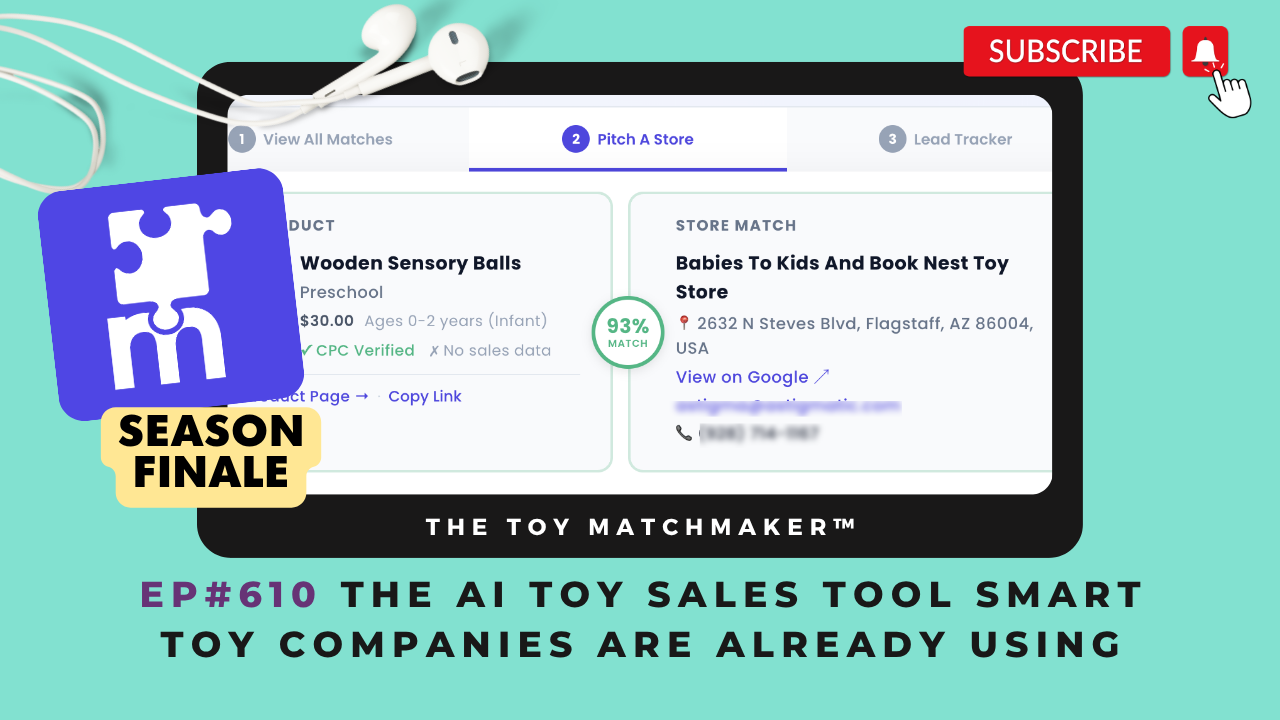
Pitch this store, and then you're brought to the sales pipeline, where you're gonna see your product, you're gonna see the store that you're matched to, you'll see the match percentage, and you're gonna see a few of the reasons why you're matched.
the most important thing On this page is where you start your outreach. underneath your product and the store that you're matched with, you'll see buttons that say email pitch, phone script, in-store pitch, Instagram or LinkedIn, pitch trade show pitch,
when you click one of these buttons, the system is gonna draft an email pitch based on your product description, your sell [00:13:00] through data. and it's going to make, the most personalized messaging that it can. You're gonna have two email types to choose from.
One that focuses on the store's customer and one that focuses on your hot product and how is a must have. After your email pitch is generated, all you have to do is click draft in Gmail or draft in Outlook and it will open up your pitch in your email client so you can send it right away.
after you start pitching a few stores, you're gonna say, where do I track all of my leads? you just go on over to the lead tracker. which has a CanBan view and a list view. so you can easily click and drag. leads from one status to another in the can bend view or in list view.
You can sort things by status, filter by product type. You can filter by hot lead, cold lead, newest, oldest. Depending on the tier of your account, you can share a view to your lead tracker, with a sales team.
If you're on the pro tier. You can also export a CSV of all of your [00:14:00] leads. this is the leads trackers where you're gonna mark, if you've pitched something, if you've won something, do follow up pitches from within the lead tracker, or try alternative pitch methods as well.
that's just the tip of the iceberg. there is an option to integrate your brand voice into your pitches.
your pitch voice could be playful, professional, bold, friendly, edgy, premium, witty, heartfelt. and you can have a style that's formal or enthusiastic or calm. Or serious or fun.
This is a great tool. If you are an independent creator, there is a starter tier But if you are a sales rep and you're like, I'm representing like, 20 something brands, there is an option for a sales rep tier where you can add.
25 brands and hundreds of products. Now there are also two other search tiers available.
One is regional and one is national. if you wanna do a regional search, you can search all of like the northeast in the us, the southeast, the Midwest, or [00:15:00] you can do a national search and search all of the US.
Now there are different types of store types you can search as well from board game cafes to bookstores, candy stores, craft stores, designer toys, discount educational stores. There is Also have mass market, mid-tier, and online retailers separated from those common store types.
demographic data to helps decide where your product is best placed. When targeting local independent stores, when we get into mid-tier stores and mass market stores and online retailers. the customer profile gets a lot broader,
the only way you can surface that data is to search mid-tier to find that buyer at Walmart.
And then that would surface the data as far as what their shopper profile is like, and if your product fits that,
So one click just generates your personalized pitch. A custom outreach email for a specific store. It's pre-written. It's ready to send. It even helps you find [00:16:00] buyer's contact info.
what makes this different from Googling or using Fair the Toy Matchmaker does not take a commission on your sales fair, takes up to a 28% commission on first orders. And that commission can really bury you if you're a small brand. the Toy Matchmaker is specifically built for people who want curated, intelligent matches for their products
and wants to give a very personalized approach to all of their different relationships between buyers and products.
This is a tool that is using AI for pattern matching at scale across data that you would just never have the time to manually process. and then it hands over the creative and the relationship work back to you.
before I go back into the rest of this episode, I have to highlight two reviews about the matchmaker Jennifer O says, the matchmaker is a valuable new tool for toy manufacturers to hone [00:17:00] in and target opportunities with toy retail stores that match better our product fit.
I found the store search extremely valuable at Uncovering leads and the pitch tools. Very helpful to put together communication plans with the stores. I believe it's a great asset for both manufacturers and retailers. the Toy Matchmaker has a retail side to it for retailers
This is also a search tool to find new products. you can use natural language to look for something you saw online and you can't quite remember the name of it, but you also have the option to fill out your store snapshot and filling out that store snapshot will allow us to run a search in our database of all of the products that our users have uploaded and find the perfect match for your store.
And There's an entire outreach process built into the retailer side as well, where you can with one click request samples, request wholesale informationand where you can track all of your contacts.
if [00:18:00] you have reached out to somebody and decided to place a purchase order and you mark that you placed a purchase order in the app, Then we will generate marketing ideas for that product for you. So it just really is a whole, like a full holistic view for both retailers and for the vendors.
We have another review from Kathy T who says, what a time saver the Toy Matchmaker makes. Searching for potential buyers for my tabletop games a breeze. I would spend hours Googling and searching if stores would be a fit for my style of games.
I would search photos of the store, read reviews, and look them up on social media only to find a few that might have potential. The Toy Matchmaker does this in seconds and with better results. best part is tracking the leads all in one easy to use platform. I'm finding so many quality leads and saving countless hours.
thank you so much, Kathy. I love to hear that. It's making me so happy
AI should help you do less, not more. You're not researching 500 [00:19:00] stores for hundreds of hours.
The tool does it for you. The Toy Matchmaker does it for you. You just focus on showing up and giving your best pitch to the right stores, But thinking back to episode four, all of this can only work because the data behind it is organized. Well, that is what this tool does for you. The tool's backend is the organization.
you come into this tool and you plop in your product details, your title, your description, your price point. and the tool utilizes that as part of its already structured system to give you a clean output.
coming back to episode five, eight, and nine, the human element still matters here.
The algorithm is only gonna take us so far. We're gonna introduce you to the best possible toy stores or game stores, or play cafes or museums for your product. But you have to take that relationship to the next level. So that's why the Toy Matchmaker has that [00:20:00] lead tracker in the final step, so that after we've found the best potential stores for you, you have a place to track and manage those leads.
This tool was built to solve a specific problem for you. So if you or your team is looking to grow your toy sales, you're looking for new retail opportunities, you've got to check out the Toy Matchmaker.
Right now the app is only open to a limited number of users, Get to thetoymatchmaker.com, enter your info, and if we still have availability, when your info comes in, we will reach out to you.
I do wanna remind you we are doing a free masterclass on AI on April 15th. So head over to the toy coach.com/ai to get signed up. The recording will not be released for free. I'm not sure if it will be released at all. So please join us live April 15th for that AI Tools for Business Masterclass there. I'm gonna be breaking down. Chacha, bt, Claude Gemini, what they're actually good for, how to stop wasting time using the wrong tool [00:21:00] for the wrong job.
I will also, if we have time, walk through the Toy Matchmaker live, link in the show notes, but again, go to the toy coach.com/ai.
Well, there you have a toy. People, thank you so much for an incredible season six of this podcast. We had a lot of new listeners coming in and joining the podcast, so thank you. I hope You enjoyed it
It is so weird for me to do a sign off on a podcast for this extended period of time. I don't even know what to say. I truly hope to see you back here September 2nd is our planned first episode of Season seven. I truly can't wait to share with you what we have in store for that season,
Please Leave a rating and review. Your reviews are what keep me coming back to deliver this podcast. Keep guests wanting to join us on this podcast, it really means so much to me
As always, [00:22:00] thank you so much for being here with me today. I know there are a ton of podcasts out there and that you lead a busy life, so it truly means the world to me that you take this time and tune in until September. I'll see you later toy person.
-
🎓 Unlock dozens of trusted factory contacts, develop your idea, and grow your toy company contact list TODAY by joining Toy Creators Academy®, learn more here.