
S6E02 | Is Amazon AI Selling Your Products Without Consent? with Angie Chua
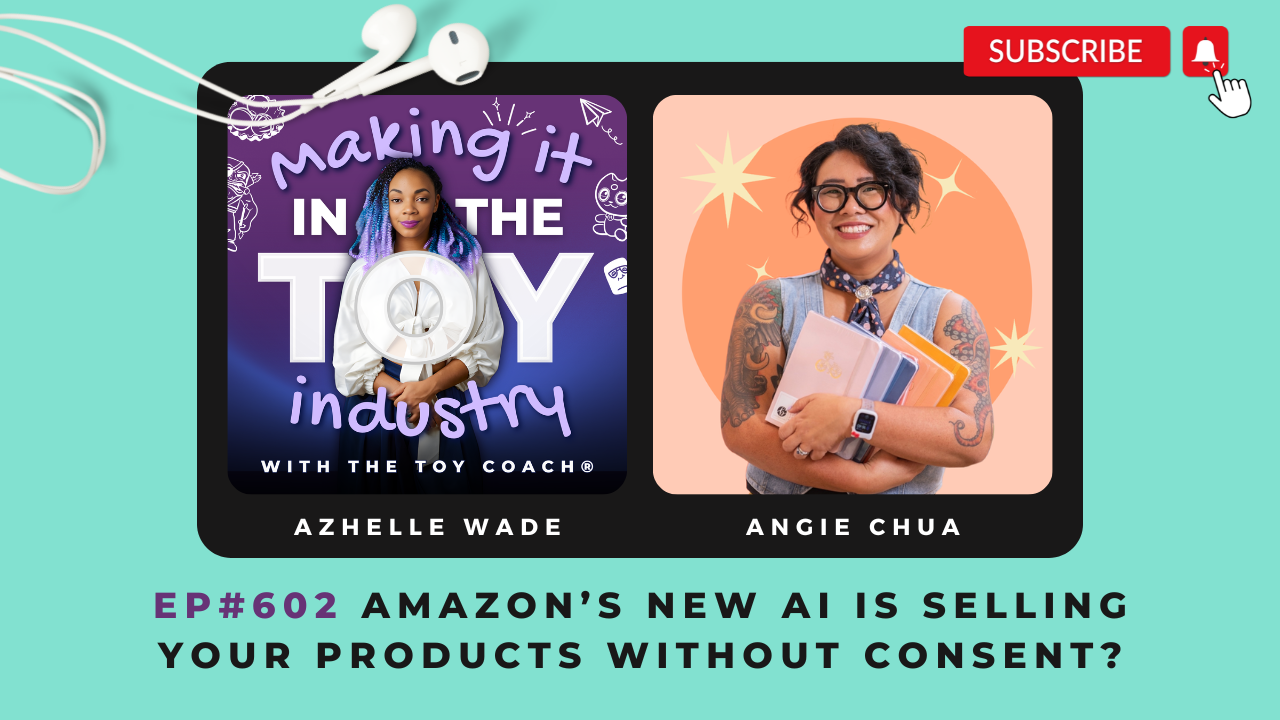
Amazon’s new “Buy For Me” button sounds helpful… but is it quietly rerouting your customers and sales without your consent? In this episode, I’m joined by Angie Chua of Bobo Design Studio to break down how this Amazon AI feature actually works, how it showed up on her shop without her opting in, and what every small business, maker, and toy brand needs to watch out for.
If you sell on your own website, Etsy, Shopify, or anywhere online, you need to understand how features like Amazon Buy For Me could impact your margins, your customer data, and the future of your business.
✨ In this episode, you’ll learn:
What the Amazon “Buy For Me” button is and how it’s using AI to complete orders
How Angie discovered strange “@buyforme.amazon” emails and what they meant for her shop
Why this feature is a potential wolf in sheep’s clothing for indie brands and toy businesses
Steps you can take to protect your customer relationships and pricing
How to think strategically about marketplaces vs your direct-to-consumer channels
For the links mentioned in this episode visit: thetoycoach.com/602
-
Are you a part of the Amazon Buy For Me program against your wishes? Band together with other creators and get on the database Angie is compiling here.
Check out Angie Chua’s website at:bobodesignstudio.com
Connect with Angie Chua online by clicking here: instagram.com/bobodesignstudioAmazon Buy For Me Trending Posts on Instagram:
https://www.instagram.com/p/DS0b82wEhLB/
https://www.instagram.com/p/DS53B7WEq3V/
https://www.instagram.com/p/DS7w6rCD7hu/
https://www.instagram.com/p/DTDvOF2gc8X/
Mistakes That Made Me Podcast: https://open.spotify.com/show/5GiaxRx0jdJaxm7i4IhrhE
-
Angie Chua: my problem is there's no accountability. We as small business owners, get canceled for the smallest stuff. a price that's too high, if we say the wrong thing we are put to the fire.
But these corporations treat their consumers like garbage and that's okay like that's okay.
Azhelle Wade: true. One time I posted an AI render of a toy and I got dragged through the coals!
Angie Chua: Yeah,
Azhelle Wade: You are listening to Making It in The Toy Industry, season six, episode two. Okay. Hey there, toy people. Azhelle Wade here and welcome back to another episode of Making It In The Toy Industry. This podcast is brought to you by the toy coach.com. Today we're talking about
a controversial AI feature that is being rolled out from one of the largest platforms in the world, and it's quietly pulling products from small shops without their consent. I wanna preface this by saying We are recording this episode, January 7th, 2026. By the time we air in February, things could have changed.Our guest today saw this firsthand and brought it to the [00:01:00] spotlight, and she's here today with us to help understand both the tech behind it and the stakes. Angie Chua is the founder and creative director of Bobo Design Studio and Bobo Palm Springs, a beloved stationary brand featured in the New York Times and the Los Angeles Times, Angie champions, makers, artists, and independent voices. And recently she shared a viral breakdown of how Amazon's new program is affecting creators.
So we're gonna talk about what's happening, why it matters, and what you can do. We should probably first state what this new, AI integration is that was discovered. I found your viral video while doom scrolling on Instagram. And what I found was Amazon has an AI powered feature where you're on Amazon's platform and when they don't have the product that you're searching for, instead of it just saying, we don't have it, it says, buy it for me. And it was buying the product from independent creator sites. And placing the order on the users behalf and then now the creator was responsible for fufilling that order . You flagged that not even the correct product is being ordered in some cases. People in your comment section seconded that and so much more. Can you tell me how you first discovered Amazon's AI buy [00:02:00] for me program.
Angie Chua: Yeah, so I had a long time customer. Send me a DM Who posted a carousel of this odd behavior that she was seeing with some of the orders that she was getting and how it might be linked to Amazon. And at the time that I saw this post, it was very early, like I think it had been maybe like a day or so, so it didn't have a lot of traction on her end.
And some of the, behavior that we saw from shoppers and purchases on our end led me to think I think we're experiencing the same thing. So during the holidays for our e-commerce shop, we sometimes get fraudulent orders because people are scamming and testing stolen credit cards during the holidays.
And the way that we can tell an order is fraudulent. it just doesn't fit the normal, shopping behavior of our customers. People don't usually buy a single eraser and then pay $7 shipping. people are usually bundling a lot of items together to basically get free shipping. And so, we started seeing some of these orders and, my first inclination is this is a weird order.
Cancel the order if it looks fraudulent. If they really wanted the item, they would write us back. But I noticed some of these, strange [00:03:00] email aliases that said, like the person might be Allison Smith, but instead of the email being Allison Smith at Gmail, it would say Liquid Squid at Buy four me dot Amazon.
And before I made the connection that we were experiencing the same thing as Hitchcock paper. I was like, oh, these are scammers. Yeah. It's not even the real name.
Azhelle Wade: I'm also surprised that the email isn't even just more professional like Amazon buy for me, right?
Angie Chua: The everything after the at symbol is. So it's, it'd be like a jumbled combination of words and then at buy for me dot Amazon. And it's similar to how if you have an Apple device and an iOS device, they have a way to like jumble and hide your email. When you're using apps. It's the same
So they're basically preventing. You from knowing who the end customer is and having a relationship with that customer. And so once we realized, yeah, that the email address was the identifier, we went back into all of our previous orders and looked at the email address and figured out which ones were coming from Amazon.
another really strange thing that had happened is. Our inventory, we were managing to sell things that were [00:04:00] drafted and out of stock. And I was like, how is that happening? We are so diligent about managing our inventory in our store, and online. And the fact that items that weren't even available were being sold made me like.
It gaslit me for a minute. I'm like, are we just not doing our jobs? Like how did we let this slide? And, I felt bad. I was giving my staff a hard time. I'm like, you guys, we gotta be on this, and in the end, we just found out it was Amazon.
Azhelle Wade: your shop is
I
Shopify? Correct.
Angie Chua: correct.
Azhelle Wade: And I, we will get into this, but I'm trying to figure out like how were drafted items getting sold.
Angie Chua: That is the million dollar question. It's not only drafted items. when you have a product listing, it's active or it's draft. So draft is if someone typed the URL 4 0 4 error, you cannot find it, but
It exists on your backend. The other thing that was really appalling is we had products that were completely deleted off of our backend listed on Amazon, under our brand name.
Azhelle Wade: I just
Angie Chua: I don't know how they got it.
I know you did an investigation. how does the program work? What did you figure out?
So essentially what we can determine from the limited information that we have is that Amazon, have decided to [00:05:00] proactively enroll independent retailers into this Buy for Me program, which allows Amazon shoppers to buy from their favorite brands directly through Amazon.
They did this without our consent. They did this without our knowledge. And they're continuing to operate under the idea that, brands can opt out whenever they want and this is good for them. Mind you, nobody's ever asked us if this is what we wanted. And so what happens is our catalog somehow is scraped.
Put into product on the Amazon app and something's more sinister is happening, is they are changing the names of the products and the product descriptions, ultimately to create an SEO battle between Amazon and us for our own products.
Azhelle Wade: Oh, how are they changing the titles?
Angie Chua: So for example, I have a product that's called, this journal will fix everything. Trinket key chain. So it's like the name of my product. This journal will fix everything. And it's a trinket key chain.
Azhelle Wade: Sounds
Angie Chua: That's the name of the product? Yeah, Amazon says trinket key chain journal book or something. Like they'll [00:06:00] completely rename it and they'll basically take the important keywords, and rearrange them in a way.
Yeah, it's pretty gross.
Azhelle Wade: So they're literally, just because the name you have is infusing personality and wit and brand identity, and they're just stripping back whatever is gonna convert based on like high, highly searched keywords.
Angie Chua: Yes.
Azhelle Wade: but then showing your product.
Angie Chua: Yes, for the most part. There were a few products where they used total AI slop, and they were completely unrelated products. I had a sticker and the sticker was like glow up sticker, and then it was a photo of some guys wearing pants.
Azhelle Wade: Oh yeah, I did see that one.
Angie Chua: Yeah.
Azhelle Wade: I wanna hear about the consequences that you've seen in customer confusion, fulfillment issues, incorrect orders. But I also wanna preface this by saying I have used, and I do use AI a lot, and so when I saw this, I'm like, oh no.
This is. AI has given some help to independent creators to allow us to do more work faster, but now it's doing obviously the same thing for the big guys, and they're using it in a way that's gonna crush us. it's just scary and it just has me going into [00:07:00] immediate problem solving mode and trying to see like, how are we gonna survive until the laws are in place to protect us.
Please tell me what are some of the consequences that you saw?
it's, to speak to your first point, I understand that AI is a helpful tool.
Yeah.
Angie Chua: I think it's best when it levels the playing field, not when it broadens the playing field.
Azhelle Wade: Yes.
Angie Chua: many consequences that I don't even like really know where to start.
But I think the most important thing is, agency and consent right by Amazon. Determining what they think our products should sound look like while attaching our names to it without our permission. Basically, strips us, strips us of our agency to manage our own brands.
Azhelle Wade: Yeah,
Angie Chua: consent of them taking our products and putting it on their site, and ultimately removing our ability to connect with that customer. It's detrimental to our businesses because, our currency and our businesses, our customer list and our email list and our communities.
And when Amazon can come in, undercut that and take away the lifetime value of every single [00:08:00] one of those purchases that consumer does not know that they're buying. direct from a small business. They just think they're on Amazon. And so there's just a really big long-term effect that I think, a lot of people in the tech industry, a lot of people at Amazon just don't understand It's gonna be one of those things that's real. They don't even really care about it the way that they use words to talk about people, as users at, we're trying to provide for our communities and they say things like, well, you just, you should be in an omnichannel, all AI driven,
they use words to completely, remove the humanity out of what it is that we do.
Azhelle Wade: side quest, the humanity, like all of these algorithms that are getting people that are giving people dopamine highs and getting them to focus and getting them to buy things could have only been determined by the pre-existence of humanity. So if you just continually humanity out of everything, eventually these marketing techniques aren't gonna work anymore.
So it's so frustrating that they want everyone to be cookie cutter, but it's if everyone is, it will not work.
Angie Chua: It is just robots talking
Azhelle Wade: six years ago I had a costume company and I had such a hard time growing it.
I didn't know what I was doing, [00:09:00] but I. Held off on putting my product on because I just could see, even from back then, once you have your product there, they know how much you're selling it for. They know how much you sell. Everybody can rip it off.
And I was like, I don't wanna lose that kind of control. I have students and clients who have very intentionally kept their product off of Amazon because of the margin that they would lose. And because they have high quality products and they don't think it associates with Amazon so now the fact that they're essentially forcing people to be associated with their brand seems like it should be illegal.
Angie Chua: Oh 1000%. They are forcing independent retailers to be a drop shipper for them. They are forcing us to participate in a race to the bottom on price. And they're forcing us to strip away all the brand equity that we've put into building a community of customers.
Azhelle Wade: Well said. Really well said. when this started happening, can you give us an idea of how many orders were coming in, and what you're seeing right now?
Angie Chua: I was super lucky. We only had maybe five or six before I started catching it. We had, one that was fulfilled and then a bunch that came in for out of stock items, which was [00:10:00] how we were able to catch it so early. I can say that others were not so lucky. I know that Sarah from Hitchcock Paper, who I first heard the story from,
When she got an order on the backend. It was completely different than what the person who was buying it on Amazon, what they were seeing.
Azhelle Wade: What do you mean?
Angie Chua: Because, maybe the product image was different, the product description was different, and ultimately she starts fulfilling these orders that are completely different than what the end consumer thinks they're purchasing.
Azhelle Wade: my
Angie Chua: let's just assume what the potential blowback could look like. We don't have the customer's email, so we have this jumbled Amazon email that goes to maybe a throwaway email that they use for Amazon, so they're not checking it. They're wondering where their products are. They're getting the wrong products, can't communicate with the seller, and they're just gonna issue a chargeback.
She might have lost the sale, the product, the chargeback fees, the cost, the emotional energy, all of that adds together. And that's just for one order. Imagine if it happens at volume. Yeah.
Azhelle Wade: the chargeback coming to Amazon?
Angie Chua: That's the thing is we don't even know, people ask this question like, well, you're getting paid. Right? And honestly, it's even hard to tell the way that Shopify reconciles payment. you don't get your payment back over two [00:11:00] days and it comes lumped together.
For me, I have several sales channels between online retail. I can't identify transaction for transaction. What is getting paid from where,
when you have these small transactions, $3, $11, $15, it's really hard to tell.
Azhelle Wade: Oh my gosh. So let's talk about Shopify. You have thought, and other people in the common section have kind of figured out that they might be playing a role in this. Like we don't know if there's like a backdoor deal. Someone's giving someone API access. So what have you actually learned about how Shopify might be involved in this Amazon Buy for me program.
Angie Chua: At this point, nothing. We're speculating. there's a lot of people screaming now. A lot of people are pissed, a lot of people are upset and rightfully so. But every single one of us cannot fight Amazon.
so I created, a Google form to help collect information. I know that it's self-reported. I just wanted to present to a lawyer how many people are affected.
And what was really interesting was there are people that were on WooCommerce, on BigCommerce, on Squarespace, and they were also seeing this happen. I think most people are on Shopify and that's probably why we're seeing such a disproportionate amount of people complaining about like, where is Shopify's POV on [00:12:00] this?
But I actually think it's like all web, which really leads me to one of my biggest gripes with Amazon is they literally own everything. They own logistics and shipping. They own media and Hollywood. Now with Amazon Prime. They own, product development with white labeling, and they literally own the internet with AWS web services.
So who knows what sort of data exists.
Azhelle Wade: II Googled, wait, does WooCommerce use Amazon Web Services? And they do. So then Shopify I'm sure does. So that might be it. That's the API access right there.
Angie Chua: Yeah. it's crazy. I am not a text luth. why can't we just get an honest answer about it?
Azhelle Wade: Holy moly. I don't even
Angie Chua: yeah, Shopify does use Amazon Web Services, even my course platform. has an upload feature, where you can upload your course documents andit was on Amazon Web Services and I, because of that, I'm not using this.
Azhelle Wade: I don't trust it.
Angie Chua: And there's people that don't even realize. the other thing that's so crazy is their only statement that I've heard from Amazon is we proactively are doing this to benefit.
other retailers and businesses.if you thought it was such a great program and it would benefit us, why not [00:13:00] Ask us to opt in. You have billions and billions of dollars. Why not create a $3 million ad campaign and ask people to apply for this program?
do you have to go into the dark of night, use it incorrectly, use it against us, put it on your site and then expect us to not know.
Azhelle Wade: no,
Angie Chua: is crazy.
Azhelle Wade: so Amazon reportedly gets 40% of online sales. So I'm sure somebody on their team is what about the other 60%? who has that? How do we get that? And then so they built this, it's brilliant. But I think they built this to gather the data so that once they know what sells from literally every small site on the web, they can, like you say, force your hand into lower prices and just make everything really cheap,
Angie Chua: they've done that.
Azhelle Wade: the right. right.
Angie Chua: Yeah, the,
Azhelle Wade: it already.
Angie Chua: they're on record. They've had several lawsuits against them. Amazon Handmade came out in maybe like 2014 or 2015 and It was their competitor to Etsy. They wanted to have market share of Etsy,
Azhelle Wade: they recruited thousands of independent indie artists, brands, Kickstarter type, product developers to sell on their [00:14:00] site and. All it did was basically bankrupt a bunch of small businesses because they figured out what products did really well.
Angie Chua: They found, third party vendors created versions of them for cheaper and then compared the two products together and they always won out on price. there are several. Big lawsuits that have come about because of that and copyright infringement, and ip and they just get buried. I even did a really hard deep dive to try and find some of these articles, but the way that the keywords are and the way they pump out press, it's literally buried.
It is so hard to find. I think I found maybe two that I could, like
Azhelle Wade: the internet,
Angie Chua: they control the internet. Yeah. And so, it's pretty crazy. that idea is rooted in truth. There's no good deed that comes from Amazon. they're doing this in a long-term play for themselves.
they're scraping. thousands and thousands of websites on Shopify, woo, all these platforms, Every single one of those clicks is money for them from data and information and owning a consumer.
Azhelle Wade: Oh no. I'm a new mom and when I need pacifiers, it takes a lot for me to just go to the Walmart down the street instead of clicking buy now on Amazon. It's hard '
[00:15:00] I see a lot of the, boycott Amazon and I 1000% get it, but I also, I think two things can happen at once. A company can have a great service. And also be really evil, but that doesn't negate the service. I have an elderly mom. She can't be going and picking up giant things of detergent.
Angie Chua: There's people that are, disabled that rely on the service. As a business owner, there are things that I cannot find anywhere else. Ultimately because Amazon's removed the competition. if I need a thermal label, for my printer, you know, there's just things you can't, it's impossible to avoid.
But that doesn't mean that they can't act ethically and like how they manage to choose to do the absolute worst thing every time and get away with it is so frustrating. But I do understand and empathize with the people that are like, just get off Amazon. But for some it's just not possible.
Azhelle Wade: This is a larger cultural issue though, because our
Angie Chua: Oh, totally.
Azhelle Wade: profit focused. Every year their CEO's coming in, like, how are we gonna increase profits? You can only fire so many people. You can only reduce costs so much. And that at some point it's we need to get more market share and we have the means to do it, so we're gonna just get, the only trajectory I can see is they get. All the market [00:16:00] share. And then when they are looking to increase profit, they raise prices and then creates an opportunity for new businesses to come in. But that, that, it's 10 years away. Okay. Let's move on to the second, angle.
I just wanna talk about the creator impact protections. You talk about a lack of consent. Can you just explain why this matters so much for small businesses and creative owners? Why aren't they just thanks for the more business, Amazon?
Angie Chua: the main thing is like ownership. you spend so much time creating something so special. The brand voice, your designs, the packaging, the story behind it. Why would you wanna give all that up? One of my favorite stories to tell, and this happened from Etsy, but there was a gal and she made, these really like cool woven bags.
It was her life. Kim Kardashian bought one of those bags, and then when she was featured in People Magazine, they asked her, where did you get it? And she said, Etsy. So not only did the woman who made it not get credit for the bag, every other dupe company out there made a version of that bag and ultimately killed her business.
So when you think Amazon is gonna give you a sale. It's at what cost and ultimately how is that going to [00:17:00] impact the specialty and the uniqueness of what it is that you do?
Azhelle Wade: Is the absolute best story and argument for not putting your product on a marketplace.
Angie Chua: That was the best argument because if one day a celebrity picks it up and talks about it, if they found you on Etsy, that's what they're gonna think it's from.
Azhelle Wade: That is so important that could be your moment.
Angie Chua: Yeah,
Azhelle Wade: Etsy. They're gonna think Amazon. Instead of thinking Joey Dolls, I went to joey dolls.com.
Angie Chua: and then they make it so hard to even find the brand name that you're shopping from. Or the store name. So it's even if they wanted to, yeah, it's like really, really difficult. when I used to have Etsy, I remember typing my own brand name and it didn't come up and I was like, what? How is like, how do I send people to my site, my page?
That was a big eye opener for me.
Azhelle Wade: what do you think people could do in this situation? What are you doing? Are you doing anything to prevent this? are you doing anything to protect your customer relationships?
Angie Chua: the first thing in context to the Amazon is if you're finding your stuff on there, take as many videos and screenshots as you possibly can. I was so furious when I saw it and I was really acting out of emotion and I didn't wanna engage with the platform and [00:18:00] give it clicks and information and data.
I just took a couple screen videos and then I tried to figure out how to get it taken down. ultimately I did by emailing, branddirect@amazon.com. I really wish I had left it up there so that I could have gotten more screenshots. So my recommendation is if you find your shop and your products.
On Amazon, take as many screenshots as you can. Maybe go through and purchase one of your own items just to see what the process is. it's a beta program, so that means people, they're AB testing. You might see buy for me links. You might see a link that takes you to your website.
Like it really, they're just playing around with ones and zeros all day.
Azhelle Wade: Just playing
Angie Chua: you.
Azhelle Wade: our livelihood.
Angie Chua: Yeah, just beep boop bop beep. we're not people, we're just cogs in a machine and we're users and we're data.
Azhelle Wade: God.
Angie Chua: once you get your canned response email from them, which is crazy 'cause they're like, we're gonna remove, we're removing you from our platform.
We'd love to hear feedback is why you want to opt out.
Azhelle Wade: you'll get that email and then over the next day or two, you'll see your products slowly start to disappear. It'll start with the image and then the products, but take as many screenshots as you can,
Angie Chua: signing up and putting your info in a Google form that I [00:19:00] have listed. we're just trying to collect and figure out how many people are directly affected. And until then, just keep an eye on your orders. Make sure that everything that you have come in is coming direct from you.
Reach out to local, government. maybe you have an assemblyman in your state that you can let them know what's happening. Try and get some press because. The one thing that we can do to impact change, I think is be unified in this, and
they cannot keep getting away with just exploiting people who don't have the means and the resources to defend themselves.
Azhelle Wade: From my experience filing trademarks, it was always important to screenshot my whole screen to include the date and time,
Gonna assume that would be important too.
Angie Chua: Yes. Just as much metadata as you can. Keep a folder, label everything. I wish I had done a better job of that.
Azhelle Wade: my biggest fear, is that there's this backlash. And then they'll just say, okay, we're gonna sunset the program, and beep boop beep, hit a couple strokes on the keyboard, and then it's gone.
Angie Chua: And then they never have toAddress this ever again. And that's my biggest problem is there's no accountability. We as small business owners, we get [00:20:00] canceled for the smallest stuff. If we have a price that's too high, if we say the wrong thing on accident, we are put to the fire.
But these corporations continue to treat their consumers like garbage and that's okay that's okay.
Azhelle Wade: true. Like one time I posted an AI render of a toy and I got dragged through the
coals
Angie Chua: Yeah,
Azhelle Wade: was like.
Angie Chua: Exactly. People spell stationary wrong and like you'd think that the world is coming to an end like they don't know it's an ERY and they sometimes stationary, a RY, it the, we're all just having a good time. Meanwhile, Amazon is literally stripping customers away let's have some perspective here, but all that to say like there is no accountability for them Go out of our ways to operate ethically and build community and support and create livable wages for people
Azhelle Wade: one thing about lawyers and then I wanna do a future projection.
Angie Chua: Okay.
Azhelle Wade: so I have a colleague who works with a law group that goes after people that knock off. Artists and put up their artwork on Amazon and sell products.
And when there's a certain amount of products, they can go after them for a lot of [00:21:00] money. And they win. And they win easily because it's easy. It's better for the companies to just pay out than to fight.
Angie Chua: Ticket versus, yeah.
Azhelle Wade: They have a product on Amazon that they're ripping off from an artist,
Angie Chua: Yeah.
Azhelle Wade: this, they're using AI generated images. So I'm wondering if that's the loophole that would be hard for a lawyer to fight. I wanna put that out there because that's just interesting and I'm curious about that. The second part is I just. I want you to help us future focus, like some people might be listening and just feel like, oh, you know what? Nevermind. I'm just gonna close up shop. Being an e-commerce person's too hard, I'm not gonna do it. why should people fight? What could be the positive outcome if we band together?
Angie Chua: The short answer is people need to see your work. Our artwork, what we provide brings joy and authenticity and connects us to the human spirit. That's more reason why you should fight.
it is the fight. I want to quit because I just want to draw and journal all day. But I know that by putting in that effort and going through the slog, like I'm actually providing joy in helping [00:22:00] maybe 15, 20, 3000, 5,000, 10,000 other people. whether or not I know it, you just, have to do it.
And I feel if you've got a talent and a gift and you have the ability and the grit, we should be responsible for putting more good things into the world.
Azhelle Wade: Thank you. That was great. I want to talk a little bit about you.
Angie Chua: I know.
Azhelle Wade: tell people who you are. So you
Angie Chua: Oh, yeah.
Azhelle Wade: digital marketing before this
Angie Chua: Yeah. I worked in digital advertising for 10 or 12 years and I left that world. it's funny I got into it because, like I know that marketing and advertising, the idea is oh, people just selling us stuff we don't need. But really what it was is like really fun creative storytelling and I got to do some really cool things with really amazing brands and partners like Mercedes and Red Bull.
And we did some really fun stuff and, as my career, got to a certain point. There was this turn where everything turned to what we called programmatic buying, and it was basically like, early versions of ai. It removed all of the human elements of creative storytelling and it was just buying ad space at [00:23:00] the cheapest point on a, on a website.
And I just really fell out of love with where the industry was going. I also did not like the organization I was with and the management and I was doing a lot of travel and I just kind of wanted to rewrite what, success looked for me. 'cause I thought it was climbing this ladder.
And so ultimately I left this job to be an artist. Mind you, I did not go to art school. I did not go to business school. I barely graduated high school. I just had the right amount of delusion and enough apathy for where I was. To just say, I'm gonna try and be an artist. And now
Azhelle Wade: This is
Angie Chua: thank you.
Azhelle Wade: You're just like articulating all of my feelings. About that
Angie Chua: Yeah like everyone's like, how'd you start your business? And I, before I did stationary, I was like making bags and I got laid off from my job and I was like, how am I gonna give Christmas gifts to friends if I have no money? So I learned how to sew and like I made these bags for people and someone's you should sell this bag.
And I was like, okay. And I went to a farmer's market and I sold one and I'm like, I guess I'm a business owner now. And that's literally how I started. And, sometimes I like constantly feel like I'm cosplaying as a [00:24:00] business owner because I'm like, every day I wake up what am I doing?
Like I don't know what I'm doing. I wanna draw. And now I'm like reading about legalese on, AI agent, whatever.
Azhelle Wade: Yeah.
Angie Chua: Aside from that, I own a stationary line and I make cool stationary and I draw and, you know, we create products that help people connect to their experiences in an analog way and, express themselves creatively.
And then, in 2021, I opened a brick and mortar retail store in Palm Springs and it's, a boutique stationary store.
Azhelle Wade: How's having a brick and mortar?
Angie Chua: It's simultaneously the most fun experience and the most exhausting. I'm like kind of an introvert, so being in store all day like. It's a high of being in the store and then it's I need seven to 10 business days to recover. But I love my team. I have a wonderful team that really support me and understand our mission.
And most importantly, love the brands that we carry. 'cause our goal there is to elevate, women of color brands, queer brands for some of the products that we carry. the stationary community is a wonderful community of people who love all things analog and want to be creative and try new things.
And so we try and [00:25:00] garner a space that allows people to fearlessly try new creative outlets and, have fun things like stickers and journals and pens.
Azhelle Wade: So what's your, flagship item that you're known for?
Angie Chua: for my particular stationary line, it's our wander list, passport travel journal. It's used by thousands of people all over the world. It helps people document their adventures. I get customers that come in all the time. I've been following you and have been using your.
wander list passport for years, which is such a great experience. And they'll come and show me like their stacks of journals that they've used, and then
Azhelle Wade: the best. getting this from my best friend. She will love this. We used to travel so much together and she would love this.
Hear this.
Angie Chua: oh,
Azhelle Wade: hear this.
Angie Chua: surprise.
Azhelle Wade: off for Roco.
Angie Chua: Where'd you get the idea for this item?
I was an avid traveler and I have a DHD.
and I hated that people would ask me like, Hey, you went to this place? Like, where'd you stay? What'd you think about it? And I'm like, I can't remember anything. I don't remember anything I did. And it seemed really silly to save all my PTO and all my money to make these memories on vacation that I have no memory of.
So I started, buying different travel journals that I was finding and none of [00:26:00] them ever worked. They always had weird questions like, what theater did you go to? And I'm like, I didn't go to a theater, or they were just like, blank. And I'm like, that's too much creative freedom. Like I don't really know where to start.
And so I also used to do a lot of diving and so I kind of modeled it after a dive log, which has a little bit of structure. there's like some area where you have like stats, so they're like very objective things.
Like where did you go? What was the weather like? What was the date? What was the location? And then there's sort of like this free area that is lightly prompted. And I loved filling that out and I always felt like it was an accomplishment to fill out a page 'cause that means I did something. And so I wanted people to have that excitement to wanna do something and fill out a page and ultimately fill out a book of all the cool things they've done.
Azhelle Wade: I love it. I love this 'cause I also collect all my, tickets from travel, but I have nothing to do with it. I just put them in a box. I don't know what to do with them. And then I have some, random Polaroids
We're gonna have matching ones. Oh my God, it's so great, Angie. I love this.
Angie Chua: Thank you.
Azhelle Wade: What are you hoping to achieve one year from now?
Angie Chua: Pro I think this is something I always like, strive for, which is just to be nicer to myself. for example, we just had our best month ever by a long [00:27:00] shot. And Thank you. And like the minute it was. January 1st. I was back to hating myself and the stress.
It's like I couldn't even celebrate the cool thing that I had done that I had worked so hard for. I think I just need to be nicer to myself. my 60% is most people's a hundred percent. if I can just be okay with that and know that, it's not the end of the world.
I think, that's something I'm always striving for is a little bit more peace and being a little nicer to myself.
Azhelle Wade: This is a question I just posed to my mastermind group. how do you celebrate? I don't think I know how,
But maybe you need to make a celebration book.
Angie Chua: I think so.
Azhelle Wade: Could you make like a book that will help us celebrate things?
Angie Chua: I'm on it. 'cause Lord knows I need it too.
Azhelle Wade: I, there's probably so many of us that need that.
Just can we take a minute and have a glass of champagne while doodling about our successes?
Angie Chua: I know. And you just think back five years ago, like even a year ago that person a year ago would've been so stoked, and I feel like I'm doing a disservice to baby me by being so jaded.
Azhelle Wade: One piece of advice that you wish more people knew about when starting a small business.
Angie Chua: Don't reinvent the wheel. There's [00:28:00] a lot of information and a lot of people that are willing to help and give you advice and share their which I think is sometimes more important than sharing their successes. And find your people and your community and lean on one another.
So sometimes you feel like you've got dumb questions and you operate in a vacuum. Don't do that. don't be afraid to find people that you can grow with. 'cause that's the coolest thing.
Azhelle Wade: yes it is. 'cause it also helps raise your self-esteem when you're like, we started together and look at you. I can do that too. I can make it
Angie Chua: Yeah.
Azhelle Wade: there. I'm gonna shout out this one podcast called Mistakes That Made Me, it literally is just everybody comes on and they have to say mistakes, so
Angie Chua: Oh my God.
Azhelle Wade: to listen
Angie Chua: I could be a guest and they'd be like, hour 3092 with Angie.
Azhelle Wade: my final question for you, my favorite question, what toy or game blew your mind as a kid?
Angie Chua: Oh my gosh. So I'm born in 81, so I'm millennial, but like to this day, it still blows my mind and I don't really know how it works. And I wish you could find it's less of a, it's more of a game. But, like mouse trap and operation. Do you remember?
Azhelle Wade: My husband works for Hasbro,
Angie Chua: [00:29:00] Stop.
Azhelle Wade: And also, yeah, and mousetrap I loved because the novelty never wore off of the game because you always lost a critical piece like two days after owning it.
Angie Chua: Oh, Angie, thank you so much for this conversation.
We had a high, we had a low, we had a scary moment. We had it all.
Azhelle Wade: for all of the links mentioned in today's episode, head over to the toy coach.com/podcast. Angie, if people listening wanna get in contact with you or wanna buy from your store, where should they go?
Angie Chua: You can find us on the web at bobodesignstudio.com, and if you find yourself in sunny Palm Springs in California cruise by our shop, we would love to have you Bobo Palm Springs Stationary Store in Palm Springs, California.
Azhelle Wade: Today we dove into what this Amazon AI powered buy from me feature actually does. the lack of consent that it's creating and how it's making real harm for our small businesses. But we also lightened it up on the brighter side. Talked about our successes this year 'cause we are slaying. We are really doing the most and we will continue to do and I just want you toy people listening to know that your brand like ours is worth fighting for. And just because AI is a new tool doesn't mean that we [00:30:00] should be pushed out because of it. We should be able to stand strong and it should be able to make the playing field level, as Angie said.
Angie Chua: Now, if you love this podcast and you haven't already left a review, what are you waiting for? Your reviews keep me coming back week after week, and it encourages guests like Angie to come and share their knowledge.
Azhelle Wade: As always, thank you so much for spending this time with us today. I know your time is valuable and that there are a ton of podcasts out there. So it truly means the world to me that you tune into this one.
Until next time, I'll see you later. Toy people.
-
🎓 Unlock dozens of trusted factory contacts, develop your idea, and grow your toy company contact list TODAY by joining Toy Creators Academy®, learn more here.